



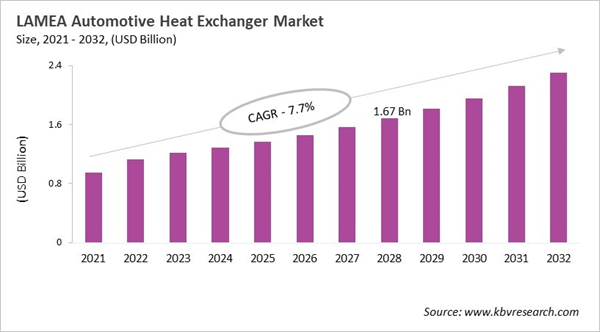
The Latin America, Middle East and Africa Automotive Heat Exchanger Market is expected to reach $1.67 billion by 2028 and is expected to witness market growth of 7.7% CAGR during the forecast period (2025-2032).
The Brazil market dominated the LAMEA Automotive Heat Exchanger Market by country in 2024, and is expected to continue to be a dominant market till 2032; thereby, achieving a market value of $420.7 million by 2032. The Argentina market is showcasing a CAGR of 8.3% during 2025-2032. Additionally, the UAE market would register a CAGR of 6.2% during 2025-2032. The Brazil and Saudi Arabia led the LAMEA Automotive Heat Exchanger Market by Country with a market share of 20.8% and 12.9% in 2024. The Nigeria market is expected to witness a CAGR of 9.4% during throughout the forecast period.
The LAMEA Automotive Heat Exchanger Market has grown from simple engine cooling systems that could handle extreme weather to a high-tech and varied industry. The market used to depend on copper and brass radiators, but it has since moved to lightweight aluminum-based solutions, which have made vehicles more fuel-efficient, improved thermal efficiency, and overall performance. As time went on, heat exchangers were used for more than just cooling engines. They were also used in HVAC and air conditioning systems to meet rising consumer expectations for comfort. More cars being made and stricter rules on emissions sped up innovation even more, which led to the use of new manufacturing methods and designs that are light and long-lasting. Today, the market is mature but still changing, and it has a wide range of products, including radiators, intercoolers, and condensers, that are made to meet the needs of different regions.
Lightweight materials, vehicle electrification, and more localized strategies are some of the trends that are driving the market right now. The switch to aluminum and composite materials helps reduce emissions, and the rise of electric and hybrid vehicles is changing how heat exchangers are used to cool batteries and power electronics. Also, changes in demand in different regions have pushed suppliers to set up production closer to customers and make solutions that are specific to certain types of cars. Industry 4.0 technologies are helping leading companies become more efficient and responsive by focusing on innovation, strategic partnerships, and expanding into new areas. The competition is still fierce, with global companies using advanced R&D and scale, while regional companies focus on low-cost, personalized products. Together, these companies drive continuous innovation and long-term growth in the market.
The Brazil market dominated the LAMEA Automotive Heat Exchanger Market by country in 2024, and is expected to continue to be a dominant market till 2032; thereby, achieving a market value of $420.7 million by 2032. The Argentina market is showcasing a CAGR of 8.3% during 2025-2032. Additionally, the UAE market would register a CAGR of 6.2% during 2025-2032. The Brazil and Saudi Arabia led the LAMEA Automotive Heat Exchanger Market by Country with a market share of 20.8% and 12.9% in 2024. The Nigeria market is expected to witness a CAGR of 9.4% during throughout the forecast period.
The LAMEA Automotive Heat Exchanger Market has grown from simple engine cooling systems that could handle extreme weather to a high-tech and varied industry. The market used to depend on copper and brass radiators, but it has since moved to lightweight aluminum-based solutions, which have made vehicles more fuel-efficient, improved thermal efficiency, and overall performance. As time went on, heat exchangers were used for more than just cooling engines. They were also used in HVAC and air conditioning systems to meet rising consumer expectations for comfort. More cars being made and stricter rules on emissions sped up innovation even more, which led to the use of new manufacturing methods and designs that are light and long-lasting. Today, the market is mature but still changing, and it has a wide range of products, including radiators, intercoolers, and condensers, that are made to meet the needs of different regions.
Lightweight materials, vehicle electrification, and more localized strategies are some of the trends that are driving the market right now. The switch to aluminum and composite materials helps reduce emissions, and the rise of electric and hybrid vehicles is changing how heat exchangers are used to cool batteries and power electronics. Also, changes in demand in different regions have pushed suppliers to set up production closer to customers and make solutions that are specific to certain types of cars. Industry 4.0 technologies are helping leading companies become more efficient and responsive by focusing on innovation, strategic partnerships, and expanding into new areas. The competition is still fierce, with global companies using advanced R&D and scale, while regional companies focus on low-cost, personalized products. Together, these companies drive continuous innovation and long-term growth in the market.
Type Outlook
Based on Type, the market is segmented into Liquid-to-Air, and Air-to-Air. With a compound annual growth rate (CAGR) of 5.7% over the projection period, the Liquid-to-Air Market, dominate the UAE Automotive Heat Exchanger Market by Type in 2024 and would be a prominent market until 2032. The Air-to-Air market is expected to witness a CAGR of 6.9% during 2025-2032.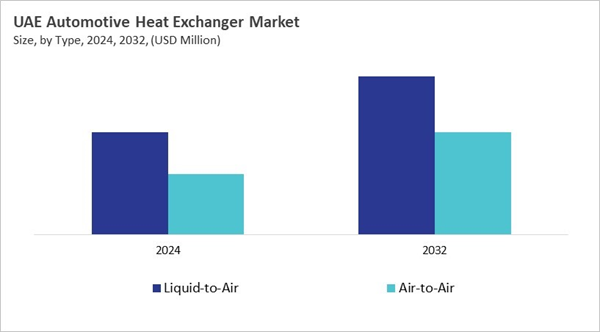
Propulsion Outlook
Based on Propulsion, the market is segmented into ICE, and Electric. The ICE market segment dominated the Brazil Automotive Heat Exchanger Market by Propulsion is expected to grow at a CAGR of 5.4 % during the forecast period thereby continuing its dominance until 2032. Also, The Electric market is anticipated to grow as a CAGR of 7.5 % during the forecast period during 2025-2032.Country Outlook
The Brazilian automotive heat exchanger market has changed from simple radiator-based cooling systems to more advanced, lightweight, and efficient thermal management solutions. This is because the country's automotive sector is growing, and environmental laws are getting stricter. As more people switch to electric and hybrid cars, demand is shifting toward specialized heat exchangers for cooling batteries and power electronics. Some important trends are a greater focus on fuel efficiency, improvements in materials like aluminum alloys, and stronger local supply chains through global partnerships. To stay competitive and improve operational efficiency, market leaders are focusing on new ideas, strategic partnerships, and making things closer to where they are needed. At the same time, fierce competition between domestic and international companies keeps pushing the market to improve technology, lower costs, and make products stand out from the rest.List of Key Companies Profiled
- Denso Corporation
- Valeo SA
- Marelli Holdings Co., Ltd.
- Mahle GmbH (Mahle Stiftung GmbH)
- Hanon Systems (Hahn & Co. Auto Holdings Co., Ltd.)
- T.RAD Co., Ltd.
- hejiang Yinlun Machinery Co., Ltd.
- Weifang Hengan Radiator Group Co., Ltd.
- Modine Manufacturing Company
- Banco Products (India) Ltd.
Market Report Segmentation
By Type- Liquid-to-Air
- Air-to-Air
- ICE
- Electric
- Passenger Cars
- Commercial Vehicles
- Brazil
- Argentina
- UAE
- Saudi Arabia
- South Africa
- Nigeria
- Rest of LAMEA
Table of Contents
Chapter 1. Market Scope & Methodology
Chapter 2. Market at a Glance
Chapter 3. Market Overview
Chapter 4. Market Trends - LAMEA Automotive Heat Exchanger Market
Chapter 5. State of Competition - LAMEA Automotive Heat Exchanger Market
Chapter 6. Market Consolidation - LAMEA Automotive Heat Exchanger Market
Chapter 7. Key Customer Criteria - LAMEA Automotive Heat Exchanger Market
Chapter 8. Product Life Cycle - LAMEA Automotive Heat Exchanger Market
Chapter 10. Competition Analysis - Global
Chapter 11. LAMEA Automotive Heat Exchanger Market by Type
Chapter 12. LAMEA Automotive Heat Exchanger Market by Propulsion
Chapter 13. LAMEA Automotive Heat Exchanger Market by Vehicle Type
Chapter 14. LAMEA Automotive Heat Exchanger Market by Country
Chapter 15. Company Profiles
Companies Mentioned
- Denso Corporation
- Valeo SA
- Marelli Holdings Co., Ltd.
- Mahle GmbH (Mahle Stiftung GmbH)
- Hanon Systems (Hahn & Co. Auto Holdings Co., Ltd.)
- T.RAD Co., Ltd.
- hejiang Yinlun Machinery Co., Ltd.
- Weifang Hengan Radiator Group Co., Ltd.
- Modine Manufacturing Company
- Banco Products (India) Ltd.


