



The North America Data Broker Market is expected to reach $128.09 billion by 2027 and is expected to witness market growth of 6.6% CAGR during the forecast period (2025-2032).
The US market dominated the North America Data Broker Market by country in 2024, and is expected to continue to be a dominant market till 2032; thereby, achieving a market value of $141.14 billion by 2032. The Canada market is experiencing a CAGR of 9.6% during 2025-2032. Additionally, the Mexico market is expected to exhibit a CAGR of 8.7% during 2025-2032. The US and Canada led the North America Data Broker Market by Country with a market share of 83% and 9% in 2024.
The North America Data Broker Market has grown along with the fast growth of online shopping, online ads, financial analytics, and services that check people's identities. Data brokers get information about people and businesses from public records, business transactions, and online activities. They then combine and analyze this information to help with marketing, risk management, fraud detection, and people search services. The industry grew from traditional credit reporting agencies and companies that sold lists for direct marketing. It grew a lot more when retail, banking, and telecommunications went digital. The Fair Credit Reporting Act (FCRA) and oversight from agencies like the Federal Trade Commission (FTC) and Consumer Financial Protection Bureau (CFPB) began to shape how businesses worked in the early 2000s. This was because more people were using the internet and digital advertising. Over time, more people have become aware of privacy issues, and regulatory scrutiny has grown. This has affected how data brokers handle transparency, consumer rights, and cross-border data governance in North America.
In today's world, the market is changing because of stricter privacy laws, the use of more advanced analytics, and the growing need for services that help people prove their identity and stop fraud. The California Consumer Privacy Act (CCPA) and the California Privacy Rights Act (CPRA) have made consumer data rights stronger. This means that businesses have to put in place stronger compliance and disclosure systems. At the same time, more and more companies are using AI, machine learning, and predictive analytics to make their risk modeling, marketing optimization, and fraud detection better. Top companies are working on things like strengthening governance frameworks, putting money into AI-driven analytics, improving cybersecurity measures, and expanding their service offerings in areas like finance, healthcare, and e-commerce. There are big multinational analytics companies and specialized data providers in a competitive environment. Differentiation is based on things like data accuracy, technological sophistication, regulatory compliance, and safe data management practices.
The US market dominated the North America Data Broker Market by country in 2024, and is expected to continue to be a dominant market till 2032; thereby, achieving a market value of $141.14 billion by 2032. The Canada market is experiencing a CAGR of 9.6% during 2025-2032. Additionally, the Mexico market is expected to exhibit a CAGR of 8.7% during 2025-2032. The US and Canada led the North America Data Broker Market by Country with a market share of 83% and 9% in 2024.
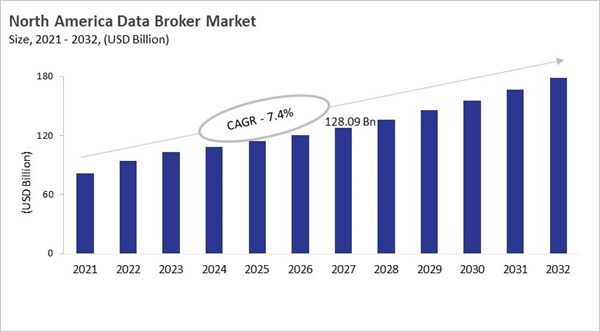
The North America Data Broker Market has grown along with the fast growth of online shopping, online ads, financial analytics, and services that check people's identities. Data brokers get information about people and businesses from public records, business transactions, and online activities. They then combine and analyze this information to help with marketing, risk management, fraud detection, and people search services. The industry grew from traditional credit reporting agencies and companies that sold lists for direct marketing. It grew a lot more when retail, banking, and telecommunications went digital. The Fair Credit Reporting Act (FCRA) and oversight from agencies like the Federal Trade Commission (FTC) and Consumer Financial Protection Bureau (CFPB) began to shape how businesses worked in the early 2000s. This was because more people were using the internet and digital advertising. Over time, more people have become aware of privacy issues, and regulatory scrutiny has grown. This has affected how data brokers handle transparency, consumer rights, and cross-border data governance in North America.
In today's world, the market is changing because of stricter privacy laws, the use of more advanced analytics, and the growing need for services that help people prove their identity and stop fraud. The California Consumer Privacy Act (CCPA) and the California Privacy Rights Act (CPRA) have made consumer data rights stronger. This means that businesses have to put in place stronger compliance and disclosure systems. At the same time, more and more companies are using AI, machine learning, and predictive analytics to make their risk modeling, marketing optimization, and fraud detection better. Top companies are working on things like strengthening governance frameworks, putting money into AI-driven analytics, improving cybersecurity measures, and expanding their service offerings in areas like finance, healthcare, and e-commerce. There are big multinational analytics companies and specialized data providers in a competitive environment. Differentiation is based on things like data accuracy, technological sophistication, regulatory compliance, and safe data management practices.
Data Type Outlook
Based on Data Type, the market is segmented into Structured Data, Unstructured Data, and Custom Structure Data. The Structured Data market segment dominated the Canada Data Broker Market by Data Type is expected to grow at a CAGR of 9.2 % during the forecast period thereby continuing its dominance until 2032. Also, The Custom Structure Data market is anticipated to grow as a CAGR of 10.5 % during the forecast period during 2025-2032.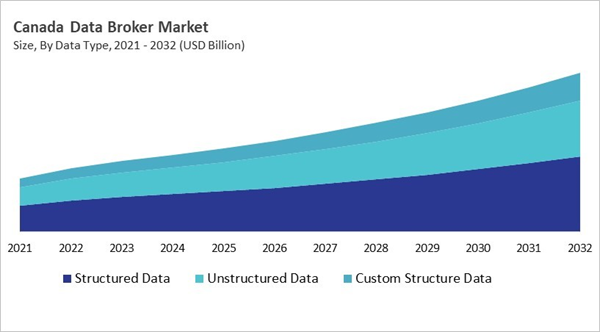
Data Category Outlook
Based on Data Category, the market is segmented into Consumer Data, Business Data, Financial Data, Health Data, and Location Data. With a compound annual growth rate (CAGR) of 4.5% over the projection period, the Consumer Data Market, dominate the US Data Broker Market by Data Category in 2024 and would be a prominent market until 2032. The Health Data market is expected to witness a CAGR of 7.3% during 2025-2032.Country Outlook
The data broker market in the United States is the most advanced and complicated in the world. It includes credit reporting agencies, marketing data firms, identity verification providers, and business intelligence companies. The Federal Trade Commission (FTC) defines data brokers as companies that gather and sell consumer information from many sources. They work in a huge digital economy with a lot of internet use, e-commerce growth, and digital advertising. The Fair Credit Reporting Act (FCRA) and the California Consumer Privacy Act (CCPA), as well as the Federal Trade Commission (FTC), have a big impact on how data is collected, used, and kept safe. Major companies like Equifax, Experian, TransUnion, and Dun & Bradstreet dominate the market with their large proprietary datasets, compliance capabilities, and advanced analytics. The market is becoming more integrated with artificial intelligence, fraud prevention technologies, and digital identity solutions. After major data breaches, companies are also putting more money into cybersecurity. The United States is still the main place for new ideas and making money in the North American data broker market, even though privacy concerns and changing laws continue to affect how businesses work.List of Key Companies Profiled
- Accenture PLC
- Equifax Inc.
- CoreLogic, Inc.
- Epsilon Data Management, LLC (Publicis Groupe)
- Oracle Corporation
- ZoomInfo Technologies Inc.
- Lusha Systems Inc.
- Clearbit (HubSpot, Inc.)
- IBM Corporation
- 6sense
Market Report Segmentation
By Data Type- Structured Data
- Unstructured Data
- Custom Structure Data
- Subscription
- Hybrid
- Pay-per-Use
- Consumer Data
- Business Data
- Financial Data
- Health Data
- Location Data
- BFSI
- Retail & E-commerce
- Media & Entertainment
- Healthcare
- IT & Telecom
- Government
- Automotive
- Other End-Use Industry
- US
- Canada
- Mexico
- Rest of North America
Table of Contents
Chapter 1. Market Scope & Methodology
Chapter 2. Market at a Glance
Chapter 3. Market Overview
Chapter 10. Competition Analysis - Global
Chapter 11. North America Data Broker Market by Data Type
Chapter 12. North America Data Broker Market by Pricing
Chapter 13. North America Data Broker Market by Data Category
Chapter 14. North America Data Broker Market by End-Use Industry
Chapter 15. North America Data Broker Market by Country
Chapter 16. Company Profiles
Companies Mentioned
- Accenture PLC
- Equifax Inc.
- CoreLogic, Inc.
- Epsilon Data Management, LLC (Publicis Groupe)
- Oracle Corporation
- ZoomInfo Technologies Inc.
- Lusha Systems Inc.
- Clearbit (HubSpot, Inc.)
- IBM Corporation
- 6sense


