



The North America Data Centre Fabric Market is expected to witness market growth of 33.1% CAGR during the forecast period (2026-2033) and is expected to attain a market size of 33.3 Billion by 2033.
The US market dominated the North America Data Centre Fabric Market by country in 2025, and is expected to continue to be a dominant market till 2033; thereby, achieving a market value of USD 24.45 billion by 2033. The Canada market is expected to witness a CAGR of 36.3% during 2026-2033. Additionally, the Mexico market is expected to witness a CAGR of 34.7% during 2026-2033. The US and Canada led the North America Data Centre Fabric Market by Country with a market share of 77.2% and 10.0% in 2025.
The market for data centre fabric in North America has grown with the region’s strong hyperscale, cloud, and enterprise data infrastructure base. The market moved away from isolated networking environments as operators adopted software-defined networking, virtualization, and automated traffic handling to support larger and more dynamic workloads. Over time, AI, big data analytics, and hybrid cloud strategies increased the need for low-latency and highly scalable interconnectivity. This has made data centre fabric a core architecture layer for modern digital infrastructure across the region.
AI-driven orchestration, sustainability targets, and distributed edge-ready architectures are shaping the current market. Operators are increasingly using automation to improve network visibility, optimize traffic, and reduce manual intervention across complex data centre environments. Energy efficiency is also becoming more important as power use and cooling demands rise. Competition is led by vendors that can combine performance, programmability, and cost efficiency while supporting cloud-native and enterprise modernization requirements.
Based on Deployment Type, the market is segmented into On-premises and Cloud. The On-premises market segment dominated the North America Data Centre Fabric Market in 2025 and is expected to continue to be a dominant segment till 2033; thereby, achieving a market value of USD 18.11 billion by 2033. The Cloud market is expected to witness a CAGR of 33.8% during 2026-2033.
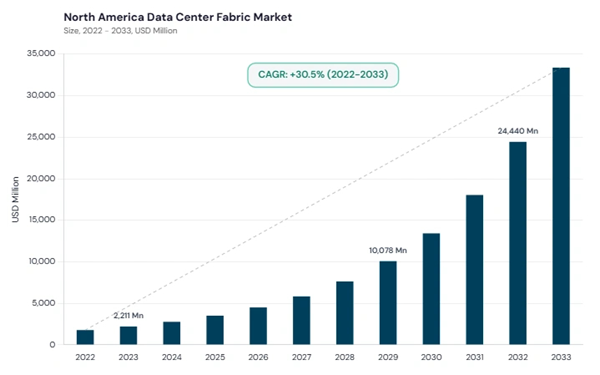
The US market dominated the North America Data Centre Fabric Market by country in 2025, and is expected to continue to be a dominant market till 2033; thereby, achieving a market value of USD 24.45 billion by 2033. The Canada market is expected to witness a CAGR of 36.3% during 2026-2033. Additionally, the Mexico market is expected to witness a CAGR of 34.7% during 2026-2033. The US and Canada led the North America Data Centre Fabric Market by Country with a market share of 77.2% and 10.0% in 2025.
The market for data centre fabric in North America has grown with the region’s strong hyperscale, cloud, and enterprise data infrastructure base. The market moved away from isolated networking environments as operators adopted software-defined networking, virtualization, and automated traffic handling to support larger and more dynamic workloads. Over time, AI, big data analytics, and hybrid cloud strategies increased the need for low-latency and highly scalable interconnectivity. This has made data centre fabric a core architecture layer for modern digital infrastructure across the region.
AI-driven orchestration, sustainability targets, and distributed edge-ready architectures are shaping the current market. Operators are increasingly using automation to improve network visibility, optimize traffic, and reduce manual intervention across complex data centre environments. Energy efficiency is also becoming more important as power use and cooling demands rise. Competition is led by vendors that can combine performance, programmability, and cost efficiency while supporting cloud-native and enterprise modernization requirements.
Deployment Type Outlook
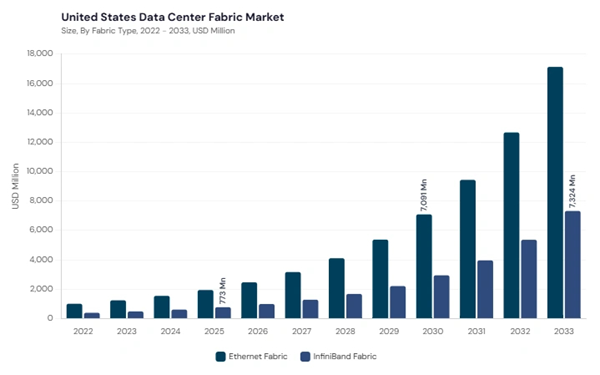
Based on Deployment Type, the market is segmented into On-premises and Cloud. The On-premises market segment dominated the North America Data Centre Fabric Market in 2025 and is expected to continue to be a dominant segment till 2033; thereby, achieving a market value of USD 18.11 billion by 2033. The Cloud market is expected to witness a CAGR of 33.8% during 2026-2033.
Solution Outlook
Based on Solution, the market is segmented into Switches, Network Fabric Software / Controllers, Storage Area Networking, Routers, and Other Solution. The Switches market segment dominated the North America Data Centre Fabric Market in 2025 and is expected to continue to be a dominant segment till 2033; thereby, achieving a market value of USD 13.45 billion by 2033. The Storage Area Networking market is expected to witness the highest CAGR of 34.2% during 2026-2033.Application Outlook
Based on Application, the market is segmented into IT & Telecommunications, BFSI, Retail & E-commerce, Healthcare, Government, and Other Application. The IT & Telecommunications market segment dominated the North America Data Centre Fabric Market in 2025 and is expected to continue to be a dominant segment till 2033; thereby, achieving a market value of USD 9.86 billion by 2033. The Retail & E-commerce market is expected to witness the highest CAGR of 34.4% during 2026-2033.End User Outlook
Based on End User, the market is segmented into Cloud Service Providers, Telecom Service Providers, Enterprises, and Colocation Providers. The Cloud Service Providers market segment dominated the North America Data Centre Fabric Market in 2025 and is expected to continue to be a dominant segment till 2033; thereby, achieving a market value of USD 13.52 billion by 2033. The Colocation Providers market is expected to witness a CAGR of 33.9% during 2026-2033.Fabric Type Outlook
Based on Fabric Type, the market is segmented into Ethernet Fabric and InfiniBand Fabric. The Ethernet Fabric market segment dominated the North America Data Centre Fabric Market in 2025 and is expected to continue to be a dominant segment till 2033; thereby, achieving a market value of USD 23.42 billion by 2033. The InfiniBand Fabric market is expected to witness a CAGR of 34.0% during 2026-2033.Country Outlook
The US data centre fabric market remains the most influential market in the region because of its hyperscale cloud concentration, large enterprise modernization cycle, and continued investment in AI-ready digital infrastructure. Demand is supported by software-led automation, low-latency networking needs, and expansion of hybrid and edge-connected architectures. Vendors are competing through programmable fabrics, stronger analytics, and better integration with cloud-native and security-focused environments. The market is also seeing more focus on power efficiency and resilient architecture design as data centre density continues to increase.List of Key Companies Profiled
- Cisco Systems, Inc.
- Arista Networks, Inc.
- Juniper Networks, Inc.
- Huawei Technologies Co., Ltd.
- Dell Technologies, Inc.
- NVIDIA Corporation
- Extreme Networks, Inc.
- VMware, Inc.
- Oracle Corporation
- Nokia Corporation
Market Report Segmentation
By Solution- Switches
- Routers
- Storage Area Networking
- Network Fabric Software / Controllers
- Other Solution
- IT & Telecommunications
- BFSI
- Healthcare
- Retail & E-commerce
- Government
- Other Application
- Cloud Service Providers
- Telecom Service Providers
- Enterprises
- Colocation Providers
- Ethernet Fabric
- InfiniBand Fabric
- On-premises
- Cloud
- US
- Canada
- Mexico
- Rest of North America
Table of Contents
Chapter 1. North America Market1.1 Market Overview
1.2 Key Factors Impacting Market
1.2.1 Market Drivers
1.2.2 Market Restraints
1.2.3 Market Opportunities
1.2.4 Market Challenges
1.2.5 Market Trends
1.2.6 State of Competition
1.2.7 Market Consolidation
1.2.8 Key Customer Criteria
1.3 Product Life Cycle
1.4 Segmentation By Solution
1.4.1 Switches
1.4.2 Routers
1.4.3 Storage Area Networking
1.4.4 Network Fabric Software / Controllers
1.4.5 Other Solution
1.5 Segmentation By Application
1.5.1 IT & Telecommunications
1.5.2 BFSI
1.5.3 Healthcare
1.5.4 Retail & E-commerce
1.5.5 Government
1.5.6 Other Application
1.6 Segmentation By End User
1.6.1 Cloud Service Providers
1.6.2 Telecom Service Providers
1.6.3 Enterprises
1.6.4 Colocation Providers
1.7 Segmentation By Fabric Type
1.7.1 Ethernet Fabric
1.7.2 InfiniBand Fabric
1.8 Segmentation By Deployment Type
1.8.1 On-Premise
1.8.2 Cloud-Based
1.9 Segmentation By Country
1.9.1 US
1.9.1.1 Segmentation By Fabric Type
1.9.1.1.1 Ethernet Fabric
1.9.1.1.2 InfiniBand Fabric
1.9.1.1.3 Cloud Service Providers
1.9.1.1.4 Telecom Service Providers
1.9.1.1.5 Enterprises
1.9.1.1.6 Colocation Providers
1.9.1.2 Segmentation By Deployment Type
1.9.1.2.1 On-premises
1.9.1.2.2 Cloud
1.9.1.2.3 Switches
1.9.1.2.4 Network Fabric Software / Controllers
1.9.1.2.5 Storage Area Networking
1.9.1.2.6 Routers
1.9.1.2.7 Other Solution
1.9.1.2.8 IT & Telecommunications
1.9.1.2.9 BFSI
1.9.1.2.10 Retail & E-commerce
1.9.1.2.11 Healthcare
1.9.1.2.12 Government
1.9.1.2.13 Other Application
1.9.2 Canada
1.9.2.1 Segmentation By Fabric Type
1.9.2.1.1 Ethernet Fabric
1.9.2.1.2 InfiniBand Fabric
1.9.2.1.3 Cloud Service Providers
1.9.2.1.4 Telecom Service Providers
1.9.2.1.5 Enterprises
1.9.2.1.6 Colocation Providers
1.9.2.2 Segmentation By Deployment Type
1.9.2.2.1 On-premises
1.9.2.2.2 Cloud
1.9.2.2.3 Switches
1.9.2.2.4 Network Fabric Software / Controllers
1.9.2.2.5 Storage Area Networking
1.9.2.2.6 Routers
1.9.2.2.7 Other Solution
1.9.2.2.8 IT & Telecommunications
1.9.2.2.9 BFSI
1.9.2.2.10 Retail & E-commerce
1.9.2.2.11 Healthcare
1.9.2.2.12 Government
1.9.2.2.13 Other Application
1.9.3 Mexico
1.9.3.1 Segmentation By Fabric Type
1.9.3.1.1 Ethernet Fabric
1.9.3.1.2 InfiniBand Fabric
1.9.3.1.3 Cloud Service Providers
1.9.3.1.4 Telecom Service Providers
1.9.3.1.5 Enterprises
1.9.3.1.6 Colocation Providers
1.9.3.2 Segmentation By Deployment Type
1.9.3.2.1 On-premises
1.9.3.2.2 Cloud
1.9.3.2.3 Switches
1.9.3.2.4 Network Fabric Software / Controllers
1.9.3.2.5 Storage Area Networking
1.9.3.2.6 Routers
1.9.3.2.7 Other Solution
1.9.3.2.8 IT & Telecommunications
1.9.3.2.9 BFSI
1.9.3.2.10 Retail & E-commerce
1.9.3.2.11 Healthcare
1.9.3.2.12 Government
1.9.3.2.13 Other Application
1.9.4 Rest of North America
1.9.4.1 Segmentation By Fabric Type
1.9.4.1.1 Ethernet Fabric
1.9.4.1.2 InfiniBand Fabric
1.9.4.1.3 Cloud Service Providers
1.9.4.1.4 Telecom Service Providers
1.9.4.1.5 Enterprises
1.9.4.1.6 Colocation Providers
1.9.4.2 Segmentation By Deployment Type
1.9.4.2.1 On-premises
1.9.4.2.2 Cloud
1.9.4.2.3 Switches
1.9.4.2.4 Network Fabric Software / Controllers
1.9.4.2.5 Storage Area Networking
1.9.4.2.6 Routers
1.9.4.2.7 Other Solution
1.9.4.2.8 IT & Telecommunications
1.9.4.2.9 BFSI
1.9.4.2.10 Retail & E-commerce
1.9.4.2.11 Healthcare
1.9.4.2.12 Government
1.9.4.2.13 Other Application
Chapter 2. Company Snapshot
2.1 Cisco Systems, Inc.
2.1.1 Business Overview
2.1.2 Key Information
2.1.3 Company Focus on Data Centre Fabric Market
2.1.4 Strategic Insights on Data Centre Fabric Market
2.1.5 Strategy Deployed for Data Centre Fabric Market
2.1.6 Product & Service Portfolio
2.1.7 Key Products / Services (Representative)
2.1.8 Capability Overview
2.1.9 SWOT Analysis (Data Centre Fabric Market)
2.1.10 Customers / End Users
2.1.11 Competitive Positioning
2.1.12 Key Differentiators
2.1.13 Portfolio Matrix
2.1.14 Analyst View
2.1.15 Future Outlook for Data Centre Fabric Market
2.2 Arista Networks, Inc.
2.2.1 Business Overview
2.2.2 Key Information
2.2.3 Company Focus on Data Centre Fabric Market
2.2.4 Strategic Insights on Data Centre Fabric Market
2.2.5 Strategy Deployed for Data Centre Fabric Market
2.2.6 Product & Service Portfolio
2.2.7 Portfolio Categories
2.2.8 Key Products / Services (Representative)
2.2.9 Capability Overview
2.2.10 Technology & Innovation Focus
2.2.11 SWOT Analysis (Data Centre Fabric Market)
2.2.12 Customers / End Users
2.2.13 Competitive Positioning
2.2.14 Key Differentiators
2.2.15 Portfolio Matrix
2.2.16 Analyst View
2.2.17 Future Outlook for Data Centre Fabric Market
2.3 Juniper Networks, Inc.
2.3.1 Business Overview
2.3.2 Key Information
2.3.3 Company Focus on Data Centre Fabric Market
2.3.4 Strategic Insights on Data Centre Fabric Market
2.3.5 Strategy Deployed for Data Centre Fabric Market
2.3.6 Product & Service Portfolio
2.3.7 Key Products / Services (Representative)
2.3.8 Capability Overview
2.3.9 SWOT Analysis (Data Centre Fabric Market)
2.3.10 Customers / End Users
2.3.11 Competitive Positioning
2.3.12 Key Differentiators
2.3.13 Portfolio Matrix
2.3.14 Analyst View
2.3.15 Future Outlook for Data Centre Fabric Market
2.4 Huawei Technologies Co., Ltd.
2.4.1 Business Overview
2.4.2 Key Information
2.4.3 Company Focus on Data Centre Fabric Market
2.4.4 Strategic Insights on Data Centre Fabric Market
2.4.5 Strategy Deployed for Data Centre Fabric Market
2.4.6 Product & Service Portfolio
2.4.7 Key Products / Services (Representative)
2.4.8 Capability Overview
2.4.9 SWOT Analysis (Data Centre Fabric Market)
2.4.10 Customers / End Users
2.4.11 Competitive Positioning
2.4.12 Key Differentiators
2.4.13 Portfolio Matrix
2.4.14 Analyst View
2.4.15 Future Outlook for Data Centre Fabric Market
2.5 Dell Technologies, Inc.
2.5.1 Business Overview
2.5.2 Key Information
2.5.3 Company Focus on Data Centre Fabric Market
2.5.4 Strategic Insights on Data Centre Fabric Market
2.5.5 Strategy Deployed for Data Centre Fabric Market
2.5.6 Product & Service Portfolio
2.5.7 Key Products / Services (Representative)
2.5.8 Capability Overview
2.5.9 Technology & Innovation Focus
2.5.10 SWOT Analysis (Data Centre Fabric Market)
2.5.11 Customers / End Users
2.5.12 Competitive Positioning
2.5.13 Key Differentiators
2.5.14 Portfolio Matrix
2.5.15 Analyst View
2.5.16 Future Outlook for Data Centre Fabric Market
2.6 NVIDIA Corporation
2.6.1 Business Overview
2.6.2 Key Information
2.6.3 Company Focus on Data Centre Fabric Market
2.6.4 Strategic Insights on Data Centre Fabric Market
2.6.5 Strategy Deployed for Data Centre Fabric Market
2.6.6 Product & Service Portfolio
2.6.7 Key Products / Services (Representative)
2.6.8 Capability Overview
2.6.9 SWOT Analysis (Data Centre Fabric Market)
2.6.10 Customers / End Users
2.6.11 Competitive Positioning
2.6.12 Key Differentiators
2.6.13 Portfolio Matrix
2.6.14 Analyst View
2.6.15 Future Outlook for Data Centre Fabric Market
2.7 Extreme Networks, Inc.
2.7.1 Business Overview
2.7.2 Key Information
2.7.3 Company Focus on Data Centre Fabric Market
2.7.4 Strategic Insights on Data Centre Fabric Market
2.7.5 Strategy Deployed for Data Centre Fabric Market
2.7.6 Product & Service Portfolio
2.7.7 Key Products / Services (Representative)
2.7.8 Technology & Innovation Focus
2.7.9 SWOT Analysis (Data Centre Fabric Market)
2.7.10 Customers / End Users
2.7.11 Competitive Positioning
2.7.12 Key Differentiators
2.7.13 Portfolio Matrix
2.7.14 Analyst View
2.7.15 Future Outlook for Data Centre Fabric Market
2.8 VMware, Inc.
2.8.1 Business Overview
2.8.2 Key Information
2.8.3 Company Focus on Data Centre Fabric Market
2.8.4 Strategic Insights on Data Centre Fabric Market
2.8.5 Strategy Deployed for Data Centre Fabric Market
2.8.6 Product & Service Portfolio
2.8.7 Key Products / Services (Representative)
2.8.8 Capability Overview
2.8.9 Technology & Innovation Focus
2.8.10 SWOT Analysis (Data Centre Fabric Market)
2.8.11 Customers / End Users
2.8.12 Competitive Positioning
2.8.13 Key Differentiators
2.8.14 Portfolio Matrix
2.8.15 Analyst View
2.8.16 Future Outlook for Data Centre Fabric Market
2.9 Oracle Corporation
2.9.1 Business Overview
2.9.2 Key Information
2.9.3 Company Focus on Data Centre Fabric Market
2.9.4 Strategic Insights on Data Centre Fabric Market
2.9.5 Strategy Deployed for Data Centre Fabric Market
2.9.6 Product & Service Portfolio
2.9.7 Key Products / Services (Representative)
2.9.8 Capability Overview
2.9.9 SWOT Analysis (Data Centre Fabric Market)
2.9.10 Customers / End Users
2.9.11 Competitive Positioning
2.9.12 Key Differentiators
2.9.13 Portfolio Matrix
2.9.14 Analyst View
2.9.15 Future Outlook for Data Centre Fabric Market
2.10 Nokia Corporation
2.10.1 Business Overview
2.10.2 Key Information
2.10.3 Company Focus on Data Centre Fabric Market
2.10.4 Strategic Insights on Data Centre Fabric Market
2.10.5 Strategy Deployed for Data Centre Fabric Market
2.10.6 Product & Service Portfolio
2.10.7 Key Products / Services (Representative)
2.10.8 Capability Overview
2.10.9 Technology & Innovation Focus
2.10.10 SWOT Analysis (Data Centre Fabric Market)
2.10.11 Customers / End Users
2.10.12 Competitive Positioning
2.10.13 Key Differentiators
2.10.14 Portfolio Matrix
2.10.15 Analyst View
2.10.16 Future Outlook for Data Centre Fabric Market
Companies Mentioned
- Cisco Systems, Inc.
- Arista Networks, Inc.
- Juniper Networks, Inc.
- Huawei Technologies Co., Ltd.
- Dell Technologies, Inc.
- NVIDIA Corporation
- Extreme Networks, Inc.
- VMware, Inc.
- Oracle Corporation
- Nokia Corporation


