



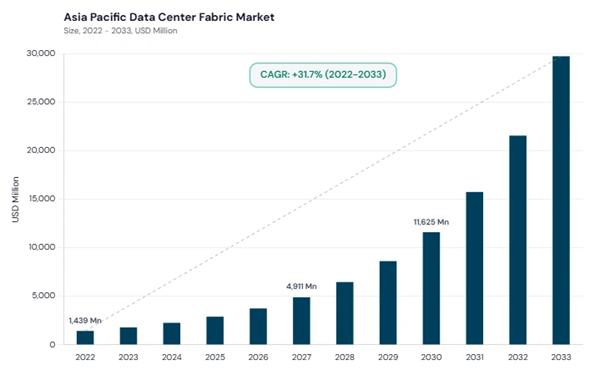
The Asia Pacific Data Centre Fabric Market is expected to witness market growth of 34.4% CAGR during the forecast period (2026-2033) reaching a market size of USD 15.7 Billion by 2031.
The China market dominated the Asia Pacific Data Centre Fabric Market by country in 2025, and is expected to continue to be a dominant market till 2033; thereby, achieving a market value of USD 8.77 billion by 2033. The Japan market is expected to witness a CAGR of 33.4% during 2026-2033. Additionally, the India market is expected to witness a CAGR of 35.5% during 2026-2033. The China and Japan led the Asia Pacific Data Centre Fabric Market by Country with a market share of 33.4% and 16.4% in 2025.
The market for data centre fabric in Asia Pacific has expanded quickly as the region built out cloud infrastructure, enterprise digital capacity, and large-scale data processing environments. Traditional networks gradually shifted toward more programmable and scalable architectures as operators needed better support for AI, multi-cloud, and latency-sensitive applications. Investments across established hubs and emerging markets have accelerated the need for high-bandwidth and low-latency connectivity. This has turned data centre fabric into a central part of regional infrastructure strategy rather than a niche networking layer.
AI-optimized networking, regional localization, and more energy-conscious infrastructure are the main themes shaping the market. Operators are deploying smarter orchestration and fault management capabilities to support heavier workloads and faster service delivery. At the same time, cloud expansion, digital sovereignty considerations, and strong growth in sectors such as e-commerce and telecom are increasing the need for adaptable and high-performance fabrics. The region remains one of the fastest-moving markets for both fabric deployment and vendor innovation.
Based on Application, the market is segmented into IT & Telecommunications, BFSI, Retail & E-commerce, Healthcare, Government, and Other Application. The IT & Telecommunications market segment dominated the Asia Pacific Data Centre Fabric Market in 2025 and is expected to continue to be a dominant segment till 2033; thereby, achieving a market value of USD 8.85 billion by 2033. The Retail & E-commerce market is expected to witness the highest CAGR of 35.7% during 2026-2033.
The China market dominated the Asia Pacific Data Centre Fabric Market by country in 2025, and is expected to continue to be a dominant market till 2033; thereby, achieving a market value of USD 8.77 billion by 2033. The Japan market is expected to witness a CAGR of 33.4% during 2026-2033. Additionally, the India market is expected to witness a CAGR of 35.5% during 2026-2033. The China and Japan led the Asia Pacific Data Centre Fabric Market by Country with a market share of 33.4% and 16.4% in 2025.
The market for data centre fabric in Asia Pacific has expanded quickly as the region built out cloud infrastructure, enterprise digital capacity, and large-scale data processing environments. Traditional networks gradually shifted toward more programmable and scalable architectures as operators needed better support for AI, multi-cloud, and latency-sensitive applications. Investments across established hubs and emerging markets have accelerated the need for high-bandwidth and low-latency connectivity. This has turned data centre fabric into a central part of regional infrastructure strategy rather than a niche networking layer.
AI-optimized networking, regional localization, and more energy-conscious infrastructure are the main themes shaping the market. Operators are deploying smarter orchestration and fault management capabilities to support heavier workloads and faster service delivery. At the same time, cloud expansion, digital sovereignty considerations, and strong growth in sectors such as e-commerce and telecom are increasing the need for adaptable and high-performance fabrics. The region remains one of the fastest-moving markets for both fabric deployment and vendor innovation.
Deployment Type Outlook
Based on Deployment Type, the market is segmented into On-premises and Cloud. The On-premises market segment dominated the Asia Pacific Data Centre Fabric Market in 2025 and is expected to continue to be a dominant segment till 2033; thereby, achieving a market value of USD 16.25 billion by 2033. The Cloud market is expected to witness a CAGR of 35.1% during 2026-2033.Solution Outlook
Based on Solution, the market is segmented into Switches, Network Fabric Software / Controllers, Storage Area Networking, Routers, and Other Solution. The Switches market segment dominated the Asia Pacific Data Centre Fabric Market in 2025 and is expected to continue to be a dominant segment till 2033; thereby, achieving a market value of USD 12.07 billion by 2033. The Storage Area Networking market is expected to witness the highest CAGR of 35.5% during 2026-2033.Application Outlook
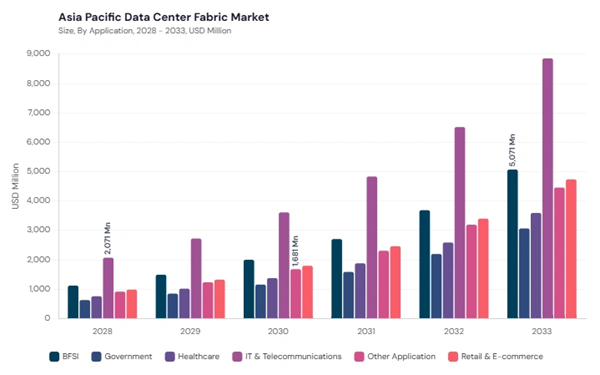
Based on Application, the market is segmented into IT & Telecommunications, BFSI, Retail & E-commerce, Healthcare, Government, and Other Application. The IT & Telecommunications market segment dominated the Asia Pacific Data Centre Fabric Market in 2025 and is expected to continue to be a dominant segment till 2033; thereby, achieving a market value of USD 8.85 billion by 2033. The Retail & E-commerce market is expected to witness the highest CAGR of 35.7% during 2026-2033.
End User Outlook
Based on End User, the market is segmented into Cloud Service Providers, Telecom Service Providers, Enterprises, and Colocation Providers. The Cloud Service Providers market segment dominated the Asia Pacific Data Centre Fabric Market in 2025 and is expected to continue to be a dominant segment till 2033; thereby, achieving a market value of USD 12.13 billion by 2033. The Colocation Providers market is expected to witness a CAGR of 35.2% during 2026-2033.Fabric Type Outlook
Based on Fabric Type, the market is segmented into Ethernet Fabric and InfiniBand Fabric. The Ethernet Fabric market segment dominated the Asia Pacific Data Centre Fabric Market in 2025 and is expected to continue to be a dominant segment till 2033; thereby, achieving a market value of USD 21.02 billion by 2033. The InfiniBand Fabric market is expected to witness a CAGR of 35.3% during 2026-2033.Country Outlook
The China data centre fabric market leads the region because of its large domestic digital infrastructure base, strong AI-related investment, and continued demand for high-performance, scalable networking environments. The market is benefiting from cloud expansion, intelligent network management, and a broader push toward localized and energy-aware infrastructure. Operators are increasingly prioritizing reliability, automation, and support for data-intensive applications across cloud, telecom, and enterprise settings. This keeps China at the center of regional capacity growth and technology direction.List of Key Companies Profiled
- Cisco Systems, Inc.
- Arista Networks, Inc.
- Juniper Networks, Inc.
- Huawei Technologies Co., Ltd.
- Dell Technologies, Inc.
- NVIDIA Corporation
- Extreme Networks, Inc.
- VMware, Inc.
- Oracle Corporation
- Nokia Corporation
Market Report Segmentation
By Solution- Switches
- Routers
- Storage Area Networking
- Network Fabric Software / Controllers
- Other Solution
- IT & Telecommunications
- BFSI
- Healthcare
- Retail & E-commerce
- Government
- Other Application
- Cloud Service Providers
- Telecom Service Providers
- Enterprises
- Colocation Providers
- Ethernet Fabric
- InfiniBand Fabric
- On-premises
- Cloud
- Japan
- China
- India
- South Korea
- Singapore
- Malaysia
- Rest of Asia Pacific
Table of Contents
Chapter 1. Asia Pacific Market1.1 Market Overview
1.2 Key Factors Impacting Market
1.2.1 Market Drivers
1.2.2 Market Restraints
1.2.3 Market Opportunities
1.2.4 Market Challenges
1.2.5 Market Trends
1.2.6 State of Competition
1.2.7 Market Consolidation
1.2.8 Key Customer Criteria
1.3 Product Life Cycle
1.4 Segmentation By Solution
1.4.1 Switches
1.4.2 Routers
1.4.3 Storage Area Networking
1.4.4 Network Fabric Software / Controllers
1.4.5 Other Solution
1.5 Segmentation By Application Analysis
1.5.1 IT & Telecommunications
1.5.2 BFSI
1.5.3 Healthcare
1.5.4 Retail & E-commerce
1.5.5 Government
1.5.6 Other Application
1.6 Segmentation By End User
1.6.1 Cloud Service Providers
1.6.2 Telecom Service Providers
1.6.3 Enterprises
1.6.4 Colocation Providers
1.7 Segmentation By Fabric Type
1.7.1 Ethernet Fabric
1.7.2 InfiniBand Fabric
1.8 Segmentation By Deployment Type
1.8.1 On-Premise
1.8.2 Cloud-Based
1.9 Segmentation By Country
1.9.1 China
1.9.1.1 Segmentation By Fabric Type
1.9.1.1.1 Ethernet Fabric
1.9.1.1.2 InfiniBand Fabric
1.9.1.1.3 Cloud Service Providers
1.9.1.1.4 Telecom Service Providers
1.9.1.1.5 Enterprises
1.9.1.1.6 Colocation Providers
1.9.1.2 Segmentation By Deployment Type
1.9.1.2.1 On-premises
1.9.1.2.2 Cloud
1.9.1.2.3 Switches
1.9.1.2.4 Network Fabric Software / Controllers
1.9.1.2.5 Storage Area Networking
1.9.1.2.6 Routers
1.9.1.2.7 Other Solution
1.9.1.2.8 IT & Telecommunications
1.9.1.2.9 BFSI
1.9.1.2.10 Retail & E-commerce
1.9.1.2.11 Healthcare
1.9.1.2.12 Government
1.9.1.2.13 Other Application
1.9.2 Japan
1.9.2.1 Segmentation By Fabric Type
1.9.2.1.1 Ethernet Fabric
1.9.2.1.2 InfiniBand Fabric
1.9.2.1.3 Cloud Service Providers
1.9.2.1.4 Telecom Service Providers
1.9.2.1.5 Enterprises
1.9.2.1.6 Colocation Providers
1.9.2.2 Segmentation By Deployment Type
1.9.2.2.1 On-premises
1.9.2.2.2 Cloud
1.9.2.2.3 Switches
1.9.2.2.4 Network Fabric Software / Controllers
1.9.2.2.5 Storage Area Networking
1.9.2.2.6 Routers
1.9.2.2.7 Other Solution
1.9.2.2.8 IT & Telecommunications
1.9.2.2.9 BFSI
1.9.2.2.10 Retail & E-commerce
1.9.2.2.11 Healthcare
1.9.2.2.12 Government
1.9.2.2.13 Other Application
1.9.3 India
1.9.3.1 Segmentation By Fabric Type
1.9.3.1.1 Ethernet Fabric
1.9.3.1.2 InfiniBand Fabric
1.9.3.1.3 Cloud Service Providers
1.9.3.1.4 Telecom Service Providers
1.9.3.1.5 Enterprises
1.9.3.1.6 Colocation Providers
1.9.3.2 Segmentation By Deployment Type
1.9.3.2.1 On-premises
1.9.3.2.2 Cloud
1.9.3.2.3 Switches
1.9.3.2.4 Network Fabric Software / Controllers
1.9.3.2.5 Storage Area Networking
1.9.3.2.6 Routers
1.9.3.2.7 Other Solution
1.9.3.2.8 IT & Telecommunications
1.9.3.2.9 BFSI
1.9.3.2.10 Retail & E-commerce
1.9.3.2.11 Healthcare
1.9.3.2.12 Government
1.9.3.2.13 Other Application
1.9.4 South Korea
1.9.4.1 Segmentation By Fabric Type
1.9.4.1.1 Ethernet Fabric
1.9.4.1.2 InfiniBand Fabric
1.9.4.1.3 Cloud Service Providers
1.9.4.1.4 Telecom Service Providers
1.9.4.1.5 Enterprises
1.9.4.1.6 Colocation Providers
1.9.4.2 Segmentation By Deployment Type
1.9.4.2.1 On-premises
1.9.4.2.2 Cloud
1.9.4.2.3 Switches
1.9.4.2.4 Network Fabric Software / Controllers
1.9.4.2.5 Storage Area Networking
1.9.4.2.6 Routers
1.9.4.2.7 Other Solution
1.9.4.2.8 IT & Telecommunications
1.9.4.2.9 BFSI
1.9.4.2.10 Retail & E-commerce
1.9.4.2.11 Healthcare
1.9.4.2.12 Government
1.9.4.2.13 Other Application
1.9.5 Singapore
1.9.5.1 Segmentation By Fabric Type
1.9.5.1.1 Ethernet Fabric
1.9.5.1.2 InfiniBand Fabric
1.9.5.1.3 Cloud Service Providers
1.9.5.1.4 Telecom Service Providers
1.9.5.1.5 Enterprises
1.9.5.1.6 Colocation Providers
1.9.5.2 Segmentation By Deployment Type
1.9.5.2.1 On-premises
1.9.5.2.2 Cloud
1.9.5.2.3 Switches
1.9.5.2.4 Network Fabric Software / Controllers
1.9.5.2.5 Storage Area Networking
1.9.5.2.6 Routers
1.9.5.2.7 Other Solution
1.9.5.2.8 IT & Telecommunications
1.9.5.2.9 BFSI
1.9.5.2.10 Retail & E-commerce
1.9.5.2.11 Healthcare
1.9.5.2.12 Government
1.9.5.2.13 Other Application
1.9.6 Malaysia
1.9.6.1 Segmentation By Fabric Type
1.9.6.1.1 Ethernet Fabric
1.9.6.1.2 InfiniBand Fabric
1.9.6.1.3 Cloud Service Providers
1.9.6.1.4 Telecom Service Providers
1.9.6.1.5 Enterprises
1.9.6.1.6 Colocation Providers
1.9.6.2 Segmentation By Deployment Type
1.9.6.2.1 On-premises
1.9.6.2.2 Cloud
1.9.6.2.3 Switches
1.9.6.2.4 Network Fabric Software / Controllers
1.9.6.2.5 Storage Area Networking
1.9.6.2.6 Routers
1.9.6.2.7 Other Solution
1.9.6.2.8 IT & Telecommunications
1.9.6.2.9 BFSI
1.9.6.2.10 Retail & E-commerce
1.9.6.2.11 Healthcare
1.9.6.2.12 Government
1.9.6.2.13 Other Application
1.9.7 Rest of Asia Pacific
1.9.7.1 Segmentation By Fabric Type
1.9.7.1.1 Ethernet Fabric
1.9.7.1.2 InfiniBand Fabric
1.9.7.1.3 Cloud Service Providers
1.9.7.1.4 Telecom Service Providers
1.9.7.1.5 Enterprises
1.9.7.1.6 Colocation Providers
1.9.7.2 Segmentation By Deployment Type
1.9.7.2.1 On-premises
1.9.7.2.2 Cloud
1.9.7.2.3 Switches
1.9.7.2.4 Network Fabric Software / Controllers
1.9.7.2.5 Storage Area Networking
1.9.7.2.6 Routers
1.9.7.2.7 Other Solution
1.9.7.2.8 IT & Telecommunications
1.9.7.2.9 BFSI
1.9.7.2.10 Retail & E-commerce
1.9.7.2.11 Healthcare
1.9.7.2.12 Government
1.9.7.2.13 Other Application
Chapter 2. Company Snapshot
2.1 Cisco Systems, Inc.
2.1.1 Business Overview
2.1.2 Key Information
2.1.3 Company Focus on Data Centre Fabric Market
2.1.4 Strategic Insights on Data Centre Fabric Market
2.1.5 Strategy Deployed for Data Centre Fabric Market
2.1.6 Product & Service Portfolio
2.1.7 Key Products / Services (Representative)
2.1.8 Capability Overview
2.1.9 SWOT Analysis (Data Centre Fabric Market)
2.1.10 Customers / End Users
2.1.11 Competitive Positioning
2.1.12 Key Differentiators
2.1.13 Portfolio Matrix
2.1.14 Analyst View
2.1.15 Future Outlook for Data Centre Fabric Market
2.2 Arista Networks, Inc.
2.2.1 Business Overview
2.2.2 Key Information
2.2.3 Company Focus on Data Centre Fabric Market
2.2.4 Strategic Insights on Data Centre Fabric Market
2.2.5 Strategy Deployed for Data Centre Fabric Market
2.2.6 Product & Service Portfolio
2.2.7 Portfolio Categories
2.2.8 Key Products / Services (Representative)
2.2.9 Capability Overview
2.2.10 Technology & Innovation Focus
2.2.11 SWOT Analysis (Data Centre Fabric Market)
2.2.12 Customers / End Users
2.2.13 Competitive Positioning
2.2.14 Key Differentiators
2.2.15 Portfolio Matrix
2.2.16 Analyst View
2.2.17 Future Outlook for Data Centre Fabric Market
2.3 Juniper Networks, Inc.
2.3.1 Business Overview
2.3.2 Key Information
2.3.3 Company Focus on Data Centre Fabric Market
2.3.4 Strategic Insights on Data Centre Fabric Market
2.3.5 Strategy Deployed for Data Centre Fabric Market
2.3.6 Product & Service Portfolio
2.3.7 Key Products / Services (Representative)
2.3.8 Capability Overview
2.3.9 SWOT Analysis (Data Centre Fabric Market)
2.3.10 Customers / End Users
2.3.11 Competitive Positioning
2.3.12 Key Differentiators
2.3.13 Portfolio Matrix
2.3.14 Analyst View
2.3.15 Future Outlook for Data Centre Fabric Market
2.4 Huawei Technologies Co., Ltd.
2.4.1 Business Overview
2.4.2 Key Information
2.4.3 Company Focus on Data Centre Fabric Market
2.4.4 Strategic Insights on Data Centre Fabric Market
2.4.5 Strategy Deployed for Data Centre Fabric Market
2.4.6 Product & Service Portfolio
2.4.7 Key Products / Services (Representative)
2.4.8 Capability Overview
2.4.9 SWOT Analysis (Data Centre Fabric Market)
2.4.10 Customers / End Users
2.4.11 Competitive Positioning
2.4.12 Key Differentiators
2.4.13 Portfolio Matrix
2.4.14 Analyst View
2.4.15 Future Outlook for Data Centre Fabric Market
2.5 Dell Technologies, Inc.
2.5.1 Business Overview
2.5.2 Key Information
2.5.3 Company Focus on Data Centre Fabric Market
2.5.4 Strategic Insights on Data Centre Fabric Market
2.5.5 Strategy Deployed for Data Centre Fabric Market
2.5.6 Product & Service Portfolio
2.5.7 Key Products / Services (Representative)
2.5.8 Capability Overview
2.5.9 Technology & Innovation Focus
2.5.10 SWOT Analysis (Data Centre Fabric Market)
2.5.11 Customers / End Users
2.5.12 Competitive Positioning
2.5.13 Key Differentiators
2.5.14 Portfolio Matrix
2.5.15 Analyst View
2.5.16 Future Outlook for Data Centre Fabric Market
2.6 NVIDIA Corporation
2.6.1 Business Overview
2.6.2 Key Information
2.6.3 Company Focus on Data Centre Fabric Market
2.6.4 Strategic Insights on Data Centre Fabric Market
2.6.5 Strategy Deployed for Data Centre Fabric Market
2.6.6 Product & Service Portfolio
2.6.7 Key Products / Services (Representative)
2.6.8 Capability Overview
2.6.9 SWOT Analysis (Data Centre Fabric Market)
2.6.10 Customers / End Users
2.6.11 Competitive Positioning
2.6.12 Key Differentiators
2.6.13 Portfolio Matrix
2.6.14 Analyst View
2.6.15 Future Outlook for Data Centre Fabric Market
2.7 Extreme Networks, Inc.
2.7.1 Business Overview
2.7.2 Key Information
2.7.3 Company Focus on Data Centre Fabric Market
2.7.4 Strategic Insights on Data Centre Fabric Market
2.7.5 Strategy Deployed for Data Centre Fabric Market
2.7.6 Product & Service Portfolio
2.7.7 Key Products / Services (Representative)
2.7.8 Technology & Innovation Focus
2.7.9 SWOT Analysis (Data Centre Fabric Market)
2.7.10 Customers / End Users
2.7.11 Competitive Positioning
2.7.12 Key Differentiators
2.7.13 Portfolio Matrix
2.7.14 Analyst View
2.7.15 Future Outlook for Data Centre Fabric Market
2.8 VMware, Inc.
2.8.1 Business Overview
2.8.2 Key Information
2.8.3 Company Focus on Data Centre Fabric Market
2.8.4 Strategic Insights on Data Centre Fabric Market
2.8.5 Strategy Deployed for Data Centre Fabric Market
2.8.6 Product & Service Portfolio
2.8.7 Key Products / Services (Representative)
2.8.8 Capability Overview
2.8.9 Technology & Innovation Focus
2.8.10 SWOT Analysis (Data Centre Fabric Market)
2.8.11 Customers / End Users
2.8.12 Competitive Positioning
2.8.13 Key Differentiators
2.8.14 Portfolio Matrix
2.8.15 Analyst View
2.8.16 Future Outlook for Data Centre Fabric Market
2.9 Oracle Corporation
2.9.1 Business Overview
2.9.2 Key Information
2.9.3 Company Focus on Data Centre Fabric Market
2.9.4 Strategic Insights on Data Centre Fabric Market
2.9.5 Strategy Deployed for Data Centre Fabric Market
2.9.6 Product & Service Portfolio
2.9.7 Key Products / Services (Representative)
2.9.8 Capability Overview
2.9.9 SWOT Analysis (Data Centre Fabric Market)
2.9.10 Customers / End Users
2.9.11 Competitive Positioning
2.9.12 Key Differentiators
2.9.13 Portfolio Matrix
2.9.14 Analyst View
2.9.15 Future Outlook for Data Centre Fabric Market
2.10 Nokia Corporation
2.10.1 Business Overview
2.10.2 Key Information
2.10.3 Company Focus on Data Centre Fabric Market
2.10.4 Strategic Insights on Data Centre Fabric Market
2.10.5 Strategy Deployed for Data Centre Fabric Market
2.10.6 Product & Service Portfolio
2.10.7 Key Products / Services (Representative)
2.10.8 Capability Overview
2.10.9 Technology & Innovation Focus
2.10.10 SWOT Analysis (Data Centre Fabric Market)
2.10.11 Customers / End Users
2.10.12 Competitive Positioning
2.10.13 Key Differentiators
2.10.14 Portfolio Matrix
2.10.15 Analyst View
2.10.16 Future Outlook for Data Centre Fabric Market
Companies Mentioned
- Cisco Systems, Inc.
- Arista Networks, Inc.
- Juniper Networks, Inc.
- Huawei Technologies Co., Ltd.
- Dell Technologies, Inc.
- NVIDIA Corporation
- Extreme Networks, Inc.
- VMware, Inc.
- Oracle Corporation
- Nokia Corporation


