



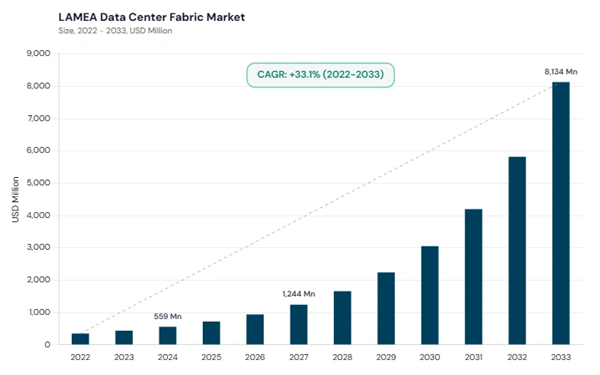
The LAMEA Data Centre Fabric Market is expected to witness market growth of 36.1% CAGR during the forecast period (2026-2033) thereby attaining a market size of 8.1 Billion by 2033.
The Brazil market dominated the LAMEA Data Centre Fabric Market by country in 2025, and is expected to continue to be a dominant market till 2033; thereby, achieving a market value of USD 1.65 billion by 2033. The Argentina market is expected to witness a CAGR of 38.1% during 2026-2033. Additionally, the UAE market is expected to witness a CAGR of 34.7% during 2026-2033. The Brazil and Rest of LAMEA led the LAMEA Data Centre Fabric Market by Country with a market share of 22.8% and 30.1% in 2025.
The market for data centre fabric in LAMEA has grown as enterprises, telecom operators, and digital service providers moved away from fragmented and less flexible network designs. Rising demand for cloud services, digital transformation, and scalable data movement has pushed operators toward more automated and resilient architectures. The market remains diverse because infrastructure maturity varies across countries, but the broader direction is clearly toward higher-performance, more programmable fabric environments. This is making modern fabric infrastructure more important for long-term digital development in the region.
Demand for low-latency and scalable architectures, stronger cost efficiency, and support for cloud-linked environments are driving market activity across LAMEA. Vendors are competing through automation, customization, and the ability to work around local infrastructure constraints. At the same time, more attention is being paid to energy efficiency and network resilience as operators scale capacity under budget pressure. This keeps the market fast-growing, but also highly sensitive to deployment economics and interoperability needs.
Based on End User, the market is segmented into Cloud Service Providers, Telecom Service Providers, Enterprises, and Colocation Providers. The Cloud Service Providers market segment dominated the LAMEA Data Centre Fabric Market in 2025 and is expected to continue to be a dominant segment till 2033; thereby, achieving a market value of USD 3.34 billion by 2033. The Colocation Providers market is expected to witness a CAGR of 37.0% during 2026-2033.
The Brazil market dominated the LAMEA Data Centre Fabric Market by country in 2025, and is expected to continue to be a dominant market till 2033; thereby, achieving a market value of USD 1.65 billion by 2033. The Argentina market is expected to witness a CAGR of 38.1% during 2026-2033. Additionally, the UAE market is expected to witness a CAGR of 34.7% during 2026-2033. The Brazil and Rest of LAMEA led the LAMEA Data Centre Fabric Market by Country with a market share of 22.8% and 30.1% in 2025.
The market for data centre fabric in LAMEA has grown as enterprises, telecom operators, and digital service providers moved away from fragmented and less flexible network designs. Rising demand for cloud services, digital transformation, and scalable data movement has pushed operators toward more automated and resilient architectures. The market remains diverse because infrastructure maturity varies across countries, but the broader direction is clearly toward higher-performance, more programmable fabric environments. This is making modern fabric infrastructure more important for long-term digital development in the region.
Demand for low-latency and scalable architectures, stronger cost efficiency, and support for cloud-linked environments are driving market activity across LAMEA. Vendors are competing through automation, customization, and the ability to work around local infrastructure constraints. At the same time, more attention is being paid to energy efficiency and network resilience as operators scale capacity under budget pressure. This keeps the market fast-growing, but also highly sensitive to deployment economics and interoperability needs.
Deployment Type Outlook
Based on Deployment Type, the market is segmented into On-premises and Cloud. The On-premises market segment dominated the LAMEA Data Centre Fabric Market in 2025 and is expected to continue to be a dominant segment till 2033; thereby, achieving a market value of USD 4.47 billion by 2033. The Cloud market is expected to witness a CAGR of 36.8% during 2026-2033.Solution Outlook
Based on Solution, the market is segmented into Switches, Network Fabric Software / Controllers, Storage Area Networking, Routers, and Other Solution. The Switches market segment dominated the LAMEA Data Centre Fabric Market in 2025 and is expected to continue to be a dominant segment till 2033; thereby, achieving a market value of USD 3.32 billion by 2033. The Storage Area Networking market is expected to witness the highest CAGR of 37.2% during 2026-2033.Application Outlook
Based on Application, the market is segmented into IT & Telecommunications, BFSI, Retail & E-commerce, Healthcare, Government, and Other Application. The IT & Telecommunications market segment dominated the LAMEA Data Centre Fabric Market in 2025 and is expected to continue to be a dominant segment till 2033; thereby, achieving a market value of USD 2.43 billion by 2033. The Retail & E-commerce market is expected to witness the highest CAGR of 37.4% during 2026-2033.End User Outlook
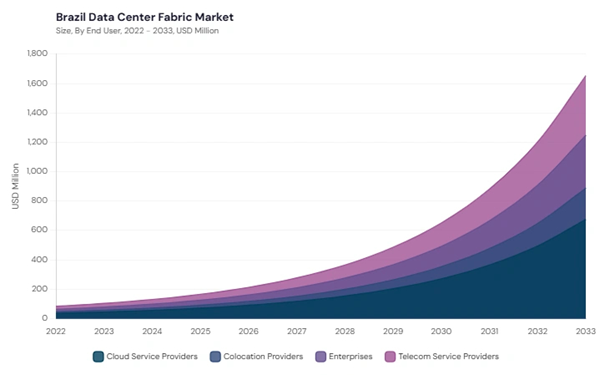
Based on End User, the market is segmented into Cloud Service Providers, Telecom Service Providers, Enterprises, and Colocation Providers. The Cloud Service Providers market segment dominated the LAMEA Data Centre Fabric Market in 2025 and is expected to continue to be a dominant segment till 2033; thereby, achieving a market value of USD 3.34 billion by 2033. The Colocation Providers market is expected to witness a CAGR of 37.0% during 2026-2033.
Fabric Type Outlook
Based on Fabric Type, the market is segmented into Ethernet Fabric and InfiniBand Fabric. The Ethernet Fabric market segment dominated the LAMEA Data Centre Fabric Market in 2025 and is expected to continue to be a dominant segment till 2033; thereby, achieving a market value of USD 5.78 billion by 2033. The InfiniBand Fabric market is expected to witness a CAGR of 37.0% during 2026-2033.Country Outlook
The Brazil data centre fabric market remains the most established country market in the region because of its expanding digital economy, stronger enterprise modernization activity, and rising demand for scalable cloud and telecom infrastructure. The market is seeing more interest in AI-led automation, hybrid cloud compatibility, and energy-aware fabric operations. Vendors are also relying on partnerships and localized deployment strategies to meet regulatory and performance needs more effectively. This keeps Brazil at the center of regional demand and long-term infrastructure investment.List of Key Companies Profiled
- Cisco Systems, Inc.
- Arista Networks, Inc.
- Juniper Networks, Inc.
- Huawei Technologies Co., Ltd.
- Dell Technologies, Inc.
- NVIDIA Corporation
- Extreme Networks, Inc.
- VMware, Inc.
- Oracle Corporation
- Nokia Corporation
Market Report Segmentation
By Solution- Switches
- Routers
- Storage Area Networking
- Network Fabric Software / Controllers
- Other Solution
- IT & Telecommunications
- BFSI
- Healthcare
- Retail & E-commerce
- Government
- Other Application
- Cloud Service Providers
- Telecom Service Providers
- Enterprises
- Colocation Providers
- Ethernet Fabric
- InfiniBand Fabric
- On-premises
- Cloud
- Brazil
- Argentina
- UAE
- Saudi Arabia
- South Africa
- Nigeria
- Rest of LAMEA
Table of Contents
Chapter 1. LAMEA Market1.1 Market Overview
1.2 Key Factors Impacting Market
1.2.1 Market Drivers
1.2.2 Market Restraints
1.2.3 Market Opportunities
1.2.4 Market Challenges
1.2.5 Market Trends
1.2.6 State of Competition
1.2.7 Market Consolidation
1.2.8 Key Customer Criteria
1.3 Product Life Cycle
1.4 Segmentation By Solution
1.4.1 Switches
1.4.2 Routers
1.4.3 Storage Area Networking
1.4.4 Network Fabric Software / Controllers
1.4.5 Other Solution
1.5 Segmentation By Application
1.5.1 IT & Telecommunications
1.5.2 BFSI
1.5.3 Healthcare
1.5.4 Retail & E-commerce
1.5.5 Government
1.5.6 Other Application
1.6 Segmentation By End User
1.6.1 Cloud Service Providers
1.6.2 Telecom Service Providers
1.6.3 Enterprises
1.6.4 Colocation Providers
1.7 Segmentation By Fabric Type
1.7.1 Ethernet Fabric
1.7.2 InfiniBand Fabric
1.8 Segmentation By Deployment Type
1.8.1 On-Premise
1.8.2 Cloud-Based
1.9 Segmentation By Country
1.9.1 Brazil
1.9.1.1 Segmentation By Fabric Type
1.9.1.1.1 Ethernet Fabric
1.9.1.1.2 InfiniBand Fabric
1.9.1.1.3 Cloud Service Providers
1.9.1.1.4 Telecom Service Providers
1.9.1.1.5 Enterprises
1.9.1.1.6 Colocation Providers
1.9.1.2 Segmentation By Deployment Type
1.9.1.2.1 On-premises
1.9.1.2.2 Cloud
1.9.1.2.3 Switches
1.9.1.2.4 Network Fabric Software / Controllers
1.9.1.2.5 Storage Area Networking
1.9.1.2.6 Routers
1.9.1.2.7 Other Solution
1.9.1.2.8 IT & Telecommunications
1.9.1.2.9 BFSI
1.9.1.2.10 Retail & E-commerce
1.9.1.2.11 Healthcare
1.9.1.2.12 Government
1.9.1.2.13 Other Application
1.9.2 Argentina
1.9.2.1 Segmentation By Fabric Type
1.9.2.1.1 Ethernet Fabric
1.9.2.1.2 InfiniBand Fabric
1.9.2.1.3 Cloud Service Providers
1.9.2.1.4 Telecom Service Providers
1.9.2.1.5 Enterprises
1.9.2.1.6 Colocation Providers
1.9.2.2 Segmentation By Deployment Type
1.9.2.2.1 On-premises
1.9.2.2.2 Cloud
1.9.2.2.3 Switches
1.9.2.2.4 Network Fabric Software / Controllers
1.9.2.2.5 Storage Area Networking
1.9.2.2.6 Routers
1.9.2.2.7 Other Solution
1.9.2.2.8 IT & Telecommunications
1.9.2.2.9 BFSI
1.9.2.2.10 Retail & E-commerce
1.9.2.2.11 Healthcare
1.9.2.2.12 Government
1.9.2.2.13 Other Application
1.9.3 UAE
1.9.3.1 Segmentation By Fabric Type
1.9.3.1.1 Ethernet Fabric
1.9.3.1.2 InfiniBand Fabric
1.9.3.1.3 Cloud Service Providers
1.9.3.1.4 Telecom Service Providers
1.9.3.1.5 Enterprises
1.9.3.1.6 Colocation Providers
1.9.3.2 Segmentation By Deployment Type
1.9.3.2.1 On-premises
1.9.3.2.2 Cloud
1.9.3.2.3 Switches
1.9.3.2.4 Network Fabric Software / Controllers
1.9.3.2.5 Storage Area Networking
1.9.3.2.6 Routers
1.9.3.2.7 Other Solution
1.9.3.2.8 IT & Telecommunications
1.9.3.2.9 BFSI
1.9.3.2.10 Retail & E-commerce
1.9.3.2.11 Healthcare
1.9.3.2.12 Government
1.9.3.2.13 Other Application
1.9.4 Saudi Arabia
1.9.4.1 Segmentation By Fabric Type
1.9.4.1.1 Ethernet Fabric
1.9.4.1.2 InfiniBand Fabric
1.9.4.1.3 Cloud Service Providers
1.9.4.1.4 Telecom Service Providers
1.9.4.1.5 Enterprises
1.9.4.1.6 Colocation Providers
1.9.4.2 Segmentation By Deployment Type
1.9.4.2.1 On-premises
1.9.4.2.2 Cloud
1.9.4.2.3 Switches
1.9.4.2.4 Network Fabric Software / Controllers
1.9.4.2.5 Storage Area Networking
1.9.4.2.6 Routers
1.9.4.2.7 Other Solution
1.9.4.2.8 IT & Telecommunications
1.9.4.2.9 BFSI
1.9.4.2.10 Retail & E-commerce
1.9.4.2.11 Healthcare
1.9.4.2.12 Government
1.9.4.2.13 Other Application
1.9.5 South Africa
1.9.5.1 Segmentation By Fabric Type
1.9.5.1.1 Ethernet Fabric
1.9.5.1.2 InfiniBand Fabric
1.9.5.1.3 Cloud Service Providers
1.9.5.1.4 Telecom Service Providers
1.9.5.1.5 Enterprises
1.9.5.1.6 Colocation Providers
1.9.5.2 Segmentation By Deployment Type
1.9.5.2.1 On-premises
1.9.5.2.2 Cloud
1.9.5.2.3 Switches
1.9.5.2.4 Network Fabric Software / Controllers
1.9.5.2.5 Storage Area Networking
1.9.5.2.6 Routers
1.9.5.2.7 Other Solution
1.9.5.2.8 IT & Telecommunications
1.9.5.2.9 BFSI
1.9.5.2.10 Retail & E-commerce
1.9.5.2.11 Healthcare
1.9.5.2.12 Government
1.9.5.2.13 Other Application
1.9.6 Nigeria
1.9.6.1 Segmentation By Fabric Type
1.9.6.1.1 Ethernet Fabric
1.9.6.1.2 InfiniBand Fabric
1.9.6.1.3 Cloud Service Providers
1.9.6.1.4 Telecom Service Providers
1.9.6.1.5 Enterprises
1.9.6.1.6 Colocation Providers
1.9.6.2 Segmentation By Deployment Type
1.9.6.2.1 On-premises
1.9.6.2.2 Cloud
1.9.6.2.3 Switches
1.9.6.2.4 Network Fabric Software / Controllers
1.9.6.2.5 Storage Area Networking
1.9.6.2.6 Routers
1.9.6.2.7 Other Solution
1.9.6.2.8 IT & Telecommunications
1.9.6.2.9 BFSI
1.9.6.2.10 Retail & E-commerce
1.9.6.2.11 Healthcare
1.9.6.2.12 Government
1.9.6.2.13 Other Application
1.9.7 Rest of LAMEA
1.9.7.1 Segmentation By Fabric Type
1.9.7.1.1 Ethernet Fabric
1.9.7.1.2 InfiniBand Fabric
1.9.7.1.3 Cloud Service Providers
1.9.7.1.4 Telecom Service Providers
1.9.7.1.5 Enterprises
1.9.7.1.6 Colocation Providers
1.9.7.2 Segmentation By Deployment Type
1.9.7.2.1 On-premises
1.9.7.2.2 Cloud
1.9.7.2.3 Switches
1.9.7.2.4 Network Fabric Software / Controllers
1.9.7.2.5 Storage Area Networking
1.9.7.2.6 Routers
1.9.7.2.7 Other Solution
1.9.7.2.8 IT & Telecommunications
1.9.7.2.9 BFSI
1.9.7.2.10 Retail & E-commerce
1.9.7.2.11 Healthcare
1.9.7.2.12 Government
1.9.7.2.13 Other Application
Chapter 2. Company Snapshot
2.1 Cisco Systems, Inc.
2.1.1 Business Overview
2.1.2 Key Information
2.1.3 Company Focus on Data Centre Fabric Market
2.1.4 Strategic Insights on Data Centre Fabric Market
2.1.5 Strategy Deployed for Data Centre Fabric Market
2.1.6 Product & Service Portfolio
2.1.7 Key Products / Services (Representative)
2.1.8 Capability Overview
2.1.9 SWOT Analysis (Data Centre Fabric Market)
2.1.10 Customers / End Users
2.1.11 Competitive Positioning
2.1.12 Key Differentiators
2.1.13 Portfolio Matrix
2.1.14 Analyst View
2.1.15 Future Outlook for Data Centre Fabric Market
2.2 Arista Networks, Inc.
2.2.1 Business Overview
2.2.2 Key Information
2.2.3 Company Focus on Data Centre Fabric Market
2.2.4 Strategic Insights on Data Centre Fabric Market
2.2.5 Strategy Deployed for Data Centre Fabric Market
2.2.6 Product & Service Portfolio
2.2.7 Portfolio Categories
2.2.8 Key Products / Services (Representative)
2.2.9 Capability Overview
2.2.10 Technology & Innovation Focus
2.2.11 SWOT Analysis (Data Centre Fabric Market)
2.2.12 Customers / End Users
2.2.13 Competitive Positioning
2.2.14 Key Differentiators
2.2.15 Portfolio Matrix
2.2.16 Analyst View
2.2.17 Future Outlook for Data Centre Fabric Market
2.3 Juniper Networks, Inc.
2.3.1 Business Overview
2.3.2 Key Information
2.3.3 Company Focus on Data Centre Fabric Market
2.3.4 Strategic Insights on Data Centre Fabric Market
2.3.5 Strategy Deployed for Data Centre Fabric Market
2.3.6 Product & Service Portfolio
2.3.7 Key Products / Services (Representative)
2.3.8 Capability Overview
2.3.9 SWOT Analysis (Data Centre Fabric Market)
2.3.10 Customers / End Users
2.3.11 Competitive Positioning
2.3.12 Key Differentiators
2.3.13 Portfolio Matrix
2.3.14 Analyst View
2.3.15 Future Outlook for Data Centre Fabric Market
2.4 Huawei Technologies Co., Ltd.
2.4.1 Business Overview
2.4.2 Key Information
2.4.3 Company Focus on Data Centre Fabric Market
2.4.4 Strategic Insights on Data Centre Fabric Market
2.4.5 Strategy Deployed for Data Centre Fabric Market
2.4.6 Product & Service Portfolio
2.4.7 Key Products / Services (Representative)
2.4.8 Capability Overview
2.4.9 SWOT Analysis (Data Centre Fabric Market)
2.4.10 Customers / End Users
2.4.11 Competitive Positioning
2.4.12 Key Differentiators
2.4.13 Portfolio Matrix
2.4.14 Analyst View
2.4.15 Future Outlook for Data Centre Fabric Market
2.5 Dell Technologies, Inc.
2.5.1 Business Overview
2.5.2 Key Information
2.5.3 Company Focus on Data Centre Fabric Market
2.5.4 Strategic Insights on Data Centre Fabric Market
2.5.5 Strategy Deployed for Data Centre Fabric Market
2.5.6 Product & Service Portfolio
2.5.7 Key Products / Services (Representative)
2.5.8 Capability Overview
2.5.9 Technology & Innovation Focus
2.5.10 SWOT Analysis (Data Centre Fabric Market)
2.5.11 Customers / End Users
2.5.12 Competitive Positioning
2.5.13 Key Differentiators
2.5.14 Portfolio Matrix
2.5.15 Analyst View
2.5.16 Future Outlook for Data Centre Fabric Market
2.6 NVIDIA Corporation
2.6.1 Business Overview
2.6.2 Key Information
2.6.3 Company Focus on Data Centre Fabric Market
2.6.4 Strategic Insights on Data Centre Fabric Market
2.6.5 Strategy Deployed for Data Centre Fabric Market
2.6.6 Product & Service Portfolio
2.6.7 Key Products / Services (Representative)
2.6.8 Capability Overview
2.6.9 SWOT Analysis (Data Centre Fabric Market)
2.6.10 Customers / End Users
2.6.11 Competitive Positioning
2.6.12 Key Differentiators
2.6.13 Portfolio Matrix
2.6.14 Analyst View
2.6.15 Future Outlook for Data Centre Fabric Market
2.7 Extreme Networks, Inc.
2.7.1 Business Overview
2.7.2 Key Information
2.7.3 Company Focus on Data Centre Fabric Market
2.7.4 Strategic Insights on Data Centre Fabric Market
2.7.5 Strategy Deployed for Data Centre Fabric Market
2.7.6 Product & Service Portfolio
2.7.7 Key Products / Services (Representative)
2.7.8 Technology & Innovation Focus
2.7.9 SWOT Analysis (Data Centre Fabric Market)
2.7.10 Customers / End Users
2.7.11 Competitive Positioning
2.7.12 Key Differentiators
2.7.13 Portfolio Matrix
2.7.14 Analyst View
2.7.15 Future Outlook for Data Centre Fabric Market
2.8 VMware, Inc.
2.8.1 Business Overview
2.8.2 Key Information
2.8.3 Company Focus on Data Centre Fabric Market
2.8.4 Strategic Insights on Data Centre Fabric Market
2.8.5 Strategy Deployed for Data Centre Fabric Market
2.8.6 Product & Service Portfolio
2.8.7 Key Products / Services (Representative)
2.8.8 Capability Overview
2.8.9 Technology & Innovation Focus
2.8.10 SWOT Analysis (Data Centre Fabric Market)
2.8.11 Customers / End Users
2.8.12 Competitive Positioning
2.8.13 Key Differentiators
2.8.14 Portfolio Matrix
2.8.15 Analyst View
2.8.16 Future Outlook for Data Centre Fabric Market
2.9 Oracle Corporation
2.9.1 Business Overview
2.9.2 Key Information
2.9.3 Company Focus on Data Centre Fabric Market
2.9.4 Strategic Insights on Data Centre Fabric Market
2.9.5 Strategy Deployed for Data Centre Fabric Market
2.9.6 Product & Service Portfolio
2.9.7 Key Products / Services (Representative)
2.9.8 Capability Overview
2.9.9 SWOT Analysis (Data Centre Fabric Market)
2.9.10 Customers / End Users
2.9.11 Competitive Positioning
2.9.12 Key Differentiators
2.9.13 Portfolio Matrix
2.9.14 Analyst View
2.9.15 Future Outlook for Data Centre Fabric Market
2.10 Nokia Corporation
2.10.1 Business Overview
2.10.2 Key Information
2.10.3 Company Focus on Data Centre Fabric Market
2.10.4 Strategic Insights on Data Centre Fabric Market
2.10.5 Strategy Deployed for Data Centre Fabric Market
2.10.6 Product & Service Portfolio
2.10.7 Key Products / Services (Representative)
2.10.8 Capability Overview
2.10.9 Technology & Innovation Focus
2.10.10 SWOT Analysis (Data Centre Fabric Market)
2.10.11 Customers / End Users
2.10.12 Competitive Positioning
2.10.13 Key Differentiators
2.10.14 Portfolio Matrix
2.10.15 Analyst View
2.10.16 Future Outlook for Data Centre Fabric Market
Companies Mentioned
- Cisco Systems, Inc.
- Arista Networks, Inc.
- Juniper Networks, Inc.
- Huawei Technologies Co., Ltd.
- Dell Technologies, Inc.
- NVIDIA Corporation
- Extreme Networks, Inc.
- VMware, Inc.
- Oracle Corporation
- Nokia Corporation


