



The North America Database Security Market is expected to witness market growth of 11.9% CAGR during the forecast period (2026-2033) and is expected to achieve a market value of USD 7.5 Billion 2032..
The US dominated the North America Database Security Market by country in 2025 and is expected to reach $6.25 Billion by 2033. The US and Canada accounted for 75.9% and 10.7% of regional revenue in 2025. Canada is expected to witness a CAGR of 13.3% during 2026-2033, followed by Mexico at 12.9%, showing that the region combines a very large US base with steady secondary-market acceleration.
The North America market evolved from basic perimeter-oriented database controls into a more layered security environment as enterprises expanded digital operations and stored larger volumes of sensitive business data. Cloud computing, big data platforms, and mobile-first business models pushed the market beyond simple encryption and access controls toward activity monitoring, data masking, dynamic encryption, and automated response. At the same time, compliance expectations in sectors such as finance and healthcare made database security a strategic operating requirement rather than a technical afterthought. The result is a mature regional market where AI-led visibility, real-time monitoring, and hybrid-environment protection are central to buying decisions.
Three themes are shaping the region: tighter compliance requirements, stronger cloud-native security adoption, and broader use of AI-driven threat analytics. Enterprises increasingly want tools that can classify data, monitor usage continuously, and enforce policy automatically across hybrid deployments. North America also shows strong demand for security platforms that integrate with larger cloud, SIEM, and orchestration stacks. As cyberattacks become more targeted and automated, buyers are putting more weight on anomaly detection, predictive intelligence, and modular deployments that can scale across large database estates.
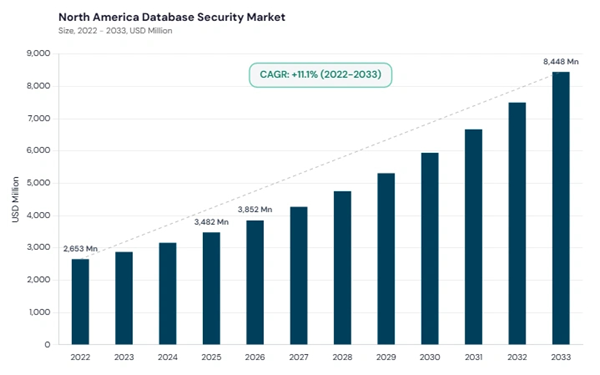
The US dominated the North America Database Security Market by country in 2025 and is expected to reach $6.25 Billion by 2033. The US and Canada accounted for 75.9% and 10.7% of regional revenue in 2025. Canada is expected to witness a CAGR of 13.3% during 2026-2033, followed by Mexico at 12.9%, showing that the region combines a very large US base with steady secondary-market acceleration.
The North America market evolved from basic perimeter-oriented database controls into a more layered security environment as enterprises expanded digital operations and stored larger volumes of sensitive business data. Cloud computing, big data platforms, and mobile-first business models pushed the market beyond simple encryption and access controls toward activity monitoring, data masking, dynamic encryption, and automated response. At the same time, compliance expectations in sectors such as finance and healthcare made database security a strategic operating requirement rather than a technical afterthought. The result is a mature regional market where AI-led visibility, real-time monitoring, and hybrid-environment protection are central to buying decisions.
Three themes are shaping the region: tighter compliance requirements, stronger cloud-native security adoption, and broader use of AI-driven threat analytics. Enterprises increasingly want tools that can classify data, monitor usage continuously, and enforce policy automatically across hybrid deployments. North America also shows strong demand for security platforms that integrate with larger cloud, SIEM, and orchestration stacks. As cyberattacks become more targeted and automated, buyers are putting more weight on anomaly detection, predictive intelligence, and modular deployments that can scale across large database estates.
Deployment Mode Outlook
Cloud dominated the market in 2025 and is expected to reach $4.37 Billion by 2033, growing at a CAGR of 12.0%. On-Premise is projected to grow at 11.7% and remains relevant for buyers that need tighter data control, stronger localization, or support for legacy environments. The regional pattern still favors cloud because enterprises increasingly want scalable controls for distributed and multi-cloud database environments.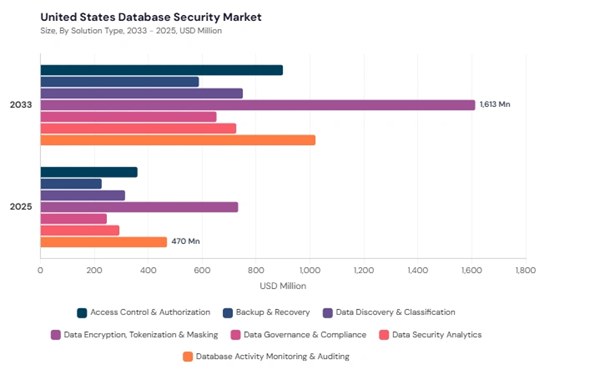
Solution Type Outlook
Data Encryption, Tokenization & Masking dominated the market and is expected to reach $2.17 Billion by 2033, growing at a CAGR of 10.9%. Access Control & Authorization is expected to post the fastest growth at 12.7%, while Database Activity Monitoring & Auditing continues to hold a large role in regulated environments. This mix reflects a market where foundational protection remains critical, but real-time identity and policy enforcement are gaining share.Industry Vertical Outlook
BFSI dominated the market and is expected to reach $1.84 Billion by 2033, growing at a CAGR of 10.7%. Retail & E-commerce is expected to register the fastest growth at 11.0%, while IT & Telecom remains another large adoption layer at 11.1% CAGR. Sensitive transaction data, fraud exposure, and strict reporting mandates keep financial services in the lead, but broader digital commerce is steadily expanding the regional opportunity set.Organization Size Outlook
Large Enterprises dominated the market and are expected to reach $5.17 Billion by 2033, growing at a CAGR of 11.4%. Small & Medium-sized Enterprises (SMEs) are projected to grow faster at 12.6% as cloud delivery lowers adoption barriers and makes advanced controls easier to consume. Large organizations still lead because they manage more complex data environments, larger compliance exposure, and broader operational risk.Country Outlook
The US remains the anchor market for database security in North America because it combines a large installed base of enterprise databases with high cyber-risk exposure and advanced cloud adoption. Organizations are increasingly shifting from control-heavy legacy models to intelligence-driven security programs that connect encryption, access management, monitoring, and automated response. Financial services, healthcare, government, and large digital platforms continue to drive spending. The US market also benefits from strong vendor presence and ecosystem partnerships, which speeds adoption of AI-led analytics and zero-trust architectures. That makes the country the region’s main reference point for integrated, enterprise-scale database protection strategies.List of Key Companies Profiled
- Oracle Corporation
- IBM Corporation
- Microsoft Corporation
- Thales Group S.A.
- Fortinet, Inc.
- McAfee, LLC
- SAP SE
- OpenText Corporation
- Cisco Systems, Inc.
- Huawei Technologies Co., Ltd.
Market Report Segmentation
By Deployment Mode- Cloud
- On-Premise
- Data Encryption, Tokenization & Masking
- Database Activity Monitoring & Auditing
- Access Control & Authorization
- Data Security Analytics
- Data Governance & Compliance
- Backup & Recovery
- Data Discovery & Classification
- Large Enterprises
- Small & Medium-sized Enterprises (SMEs)
- BFSI
- IT & Telecom
- Retail & E-commerce
- Government & Defense
- Healthcare & Life Sciences
- Energy & Utilities
- Education
- Other Industry Vertical
- US
- Canada
- Mexico
- Rest of North America
Table of Contents
Chapter 1. North America Market1.1 Market Overview
1.2 Key Factors Impacting Market
1.2.1 Market Drivers
1.2.2 Market Restraints
1.2.3 Market Opportunities
1.2.4 Market Challenges
1.2.5 Market Trends
1.2.6 State of Competition
1.2.7 Market Consolidation
1.2.8 Key Customer Criteria
1.3 Product Life Cycle
1.4 Segmentation By Deployment Mode
1.4.1 Cloud
1.4.2 On-Premise
1.5 Segmentation By Organization Size
1.5.1 Large Enterprises
1.5.2 Small & Medium-sized Enterprises (SMEs)
1.6 Segmentation By Solution Type
1.6.1 Data Discovery & Classification
1.6.2 Data Encryption, Tokenization & Masking
1.6.3 Database Activity Monitoring & Auditing
1.6.4 Access Control & Authorization
1.6.5 Data Security Analytics
1.6.6 Backup & Recovery
1.6.7 Data Governance & Compliance
1.7 Segmentation By Industry Vertical
1.7.1 BFSI
1.7.2 IT & Telecom
1.7.3 Retail & E-commerce
1.7.4 Government & Defense
1.7.5 Healthcare & Life Sciences
1.7.6 Energy & Utilities
1.7.7 Education
1.7.8 Other Industry Vertical
1.8 Segmentation By Country
1.8.1 US
1.8.1.1 Segmentation By Deployment Mode
1.8.1.1.1 Cloud
1.8.1.1.2 On-Premise
1.8.1.2 Segmentation By Organization Size
1.8.1.2.1 Large Enterprises
1.8.1.2.2 Small & Medium-sized Enterprises (SMEs)
1.8.1.3 Segmentation By Solution Type
1.8.1.3.1 Data Discovery & Classification
1.8.1.3.2 Data Encryption, Tokenization & Masking
1.8.1.3.3 Database Activity Monitoring & Auditing
1.8.1.3.4 Access Control & Authorization
1.8.1.3.5 Data Security Analytics
1.8.1.3.6 Backup & Recovery
1.8.1.3.7 Data Governance & Compliance
1.8.1.4 Segmentation By Industry Vertical
1.8.1.4.1 BFSI
1.8.1.4.2 IT & Telecom
1.8.1.4.3 Retail & E-commerce
1.8.1.4.4 Government & Defense
1.8.1.4.5 Healthcare & Life Sciences
1.8.1.4.6 Energy & Utilities
1.8.1.4.7 Education
1.8.1.4.8 Other Industry Vertical
1.8.2 Canada
1.8.2.1 Segmentation By Deployment Mode
1.8.2.1.1 Cloud
1.8.2.1.2 On-Premise
1.8.2.2 Segmentation By Organization Size
1.8.2.2.1 Large Enterprises
1.8.2.2.2 Small & Medium-sized Enterprises (SMEs)
1.8.2.3 Segmentation By Solution Type
1.8.2.3.1 Data Discovery & Classification
1.8.2.3.2 Data Encryption, Tokenization & Masking
1.8.2.3.3 Database Activity Monitoring & Auditing
1.8.2.3.4 Access Control & Authorization
1.8.2.3.5 Data Security Analytics
1.8.2.3.6 Backup & Recovery
1.8.2.3.7 Data Governance & Compliance
1.8.2.4 Segmentation By Industry Vertical
1.8.2.4.1 BFSI
1.8.2.4.2 IT & Telecom
1.8.2.4.3 Retail & E-commerce
1.8.2.4.4 Government & Defense
1.8.2.4.5 Healthcare & Life Sciences
1.8.2.4.6 Energy & Utilities
1.8.2.4.7 Education
1.8.2.4.8 Other Industry Vertical
1.8.3 Mexico
1.8.3.1 Segmentation By Deployment Mode
1.8.3.1.1 Cloud
1.8.3.1.2 On-Premise
1.8.3.2 Segmentation By Organization Size
1.8.3.2.1 Large Enterprises
1.8.3.2.2 Small & Medium-sized Enterprises (SMEs)
1.8.3.3 Segmentation By Solution Type
1.8.3.3.1 Data Discovery & Classification
1.8.3.3.2 Data Encryption, Tokenization & Masking
1.8.3.3.3 Database Activity Monitoring & Auditing
1.8.3.3.4 Access Control & Authorization
1.8.3.3.5 Data Security Analytics
1.8.3.3.6 Backup & Recovery
1.8.3.3.7 Data Governance & Compliance
1.8.3.4 Segmentation By Industry Vertical
1.8.3.4.1 BFSI
1.8.3.4.2 IT & Telecom
1.8.3.4.3 Retail & E-commerce
1.8.3.4.4 Government & Defense
1.8.3.4.5 Healthcare & Life Sciences
1.8.3.4.6 Energy & Utilities
1.8.3.4.7 Education
1.8.3.4.8 Other Industry Vertical
1.8.4 Rest of North America
1.8.4.1 Segmentation By Deployment Mode
1.8.4.1.1 Cloud
1.8.4.1.2 On-Premise
1.8.4.2 Segmentation By Organization Size
1.8.4.2.1 Large Enterprises
1.8.4.2.2 Small & Medium-sized Enterprises (SMEs)
1.8.4.3 Segmentation By Solution Type
1.8.4.3.1 Data Discovery & Classification
1.8.4.3.2 Data Encryption, Tokenization & Masking
1.8.4.3.3 Database Activity Monitoring & Auditing
1.8.4.3.4 Access Control & Authorization
1.8.4.3.5 Data Security Analytics
1.8.4.3.6 Backup & Recovery
1.8.4.3.7 Data Governance & Compliance
1.8.4.4 Segmentation By Industry Vertical
1.8.4.4.1 BFSI
1.8.4.4.2 IT & Telecom
1.8.4.4.3 Retail & E-commerce
1.8.4.4.4 Government & Defense
1.8.4.4.5 Healthcare & Life Sciences
1.8.4.4.6 Energy & Utilities
1.8.4.4.7 Education
1.8.4.4.8 Other Industry Vertical
Chapter 2. Company Snapshot
2.1 IBM Corporation
2.1.1 Business Overview
2.1.2 Key Information
2.1.3 Company Focus
2.1.4 Strategic Insights
2.1.5 Strategy Deployed
2.1.6 Product & Service Portfolio
2.1.7 Capability Overview
2.1.8 Technology & Innovation Focus
2.1.9 Customers / End Users
2.1.10 Competitive Positioning
2.1.11 Key Differentiators
2.1.12 Portfolio Matrix
2.1.13 SWOT Analysis
2.1.14 Future Outlook
2.2 Oracle Corporation
2.2.1 Business Overview
2.2.2 Key Information
2.2.3 Company Focus
2.2.4 Strategic Insights
2.2.5 Strategy Deployed
2.2.6 Product & Service Portfolio
2.2.7 Capability Overview
2.2.8 Technology & Innovation Focus
2.2.9 Customers / End Users
2.2.10 Competitive Positioning
2.2.11 Key Differentiators
2.2.12 Portfolio Matrix
2.2.13 SWOT Analysis
2.2.14 Future Outlook
2.3 Microsoft Corporation
2.3.1 Business Overview
2.3.2 Key Information
2.3.3 Company Focus
2.3.4 Strategic Insights
2.3.5 Strategy Deployed
2.3.6 Product & Service Portfolio
2.3.7 Capability Overview
2.3.8 Technology & Innovation Focus
2.3.9 Customers / End Users
2.3.10 Competitive Positioning
2.3.11 Key Differentiators
2.3.12 Portfolio Matrix
2.3.13 SWOT Analysis
2.3.14 Future Outlook
2.4 McAfee Corp.
2.4.1 Business Overview
2.4.2 Key Information
2.4.3 Company Focus
2.4.4 Strategic Insights
2.4.5 Strategy Deployed
2.4.6 Product & Service Portfolio
2.4.7 Capability Overview
2.4.8 Technology & Innovation Focus
2.4.9 Customers / End Users
2.4.10 Competitive Positioning
2.4.11 Key Differentiators
2.4.12 Portfolio Matrix
2.4.13 SWOT Analysis
2.4.14 Future Outlook
2.5 Fortinet, Inc.
2.5.1 Business Overview
2.5.2 Key Information
2.5.3 Company Focus
2.5.4 Strategic Insights
2.5.5 Strategy Deployed
2.5.6 Product & Service Portfolio
2.5.7 Capability Overview
2.5.8 Technology & Innovation Focus
2.5.9 Customers / End Users
2.5.10 Competitive Positioning
2.5.11 Key Differentiators
2.5.12 Portfolio Matrix
2.5.13 SWOT Analysis
2.5.14 Future Outlook
2.6 Thales Group S.A.
2.6.1 Business Overview
2.6.2 Key Information
2.6.3 Company Focus
2.6.4 Strategic Insights
2.6.5 Strategy Deployed
2.6.6 Product & Service Portfolio
2.6.7 Capability Overview
2.6.8 Technology & Innovation Focus
2.6.9 Customers / End Users
2.6.10 Competitive Positioning
2.6.11 Key Differentiators
2.6.12 Portfolio Matrix
2.6.13 SWOT Analysis
2.6.14 Future Outlook
2.7 SAP SE
2.7.1 Business Overview
2.7.2 Key Information
2.7.3 Company Focus
2.7.4 Strategic Insights
2.7.5 Strategy Deployed
2.7.6 Product & Service Portfolio
2.7.7 Capability Overview
2.7.8 Technology & Innovation Focus
2.7.9 Customers / End Users
2.7.10 Competitive Positioning
2.7.11 Key Differentiators
2.7.12 Portfolio Matrix
2.7.13 SWOT Analysis
2.7.14 Future Outlook
2.8 Open Text Corporation
2.8.1 Business Overview
2.8.2 Key Information
2.8.3 Company Focus
2.8.4 Strategic Insights
2.8.5 Strategy Deployed
2.8.6 Product & Service Portfolio
2.8.7 Capability Overview
2.8.8 Technology & Innovation Focus
2.8.9 Customers / End Users
2.8.10 Competitive Positioning
2.8.11 Key Differentiators
2.8.12 Portfolio Matrix
2.8.13 SWOT Analysis
2.8.14 Future Outlook
2.9 Cisco Systems, Inc.
2.9.1 Business Overview
2.9.2 Key Information
2.9.3 Company Focus
2.9.4 Strategic Insights
2.9.5 Strategy Deployed
2.9.6 Product & Service Portfolio
2.9.7 Capability Overview
2.9.8 Technology & Innovation Focus
2.9.9 Customers / End Users
2.9.10 Competitive Positioning
2.9.11 Key Differentiators
2.9.12 Portfolio Matrix
2.9.13 SWOT Analysis
2.9.14 Future Outlook
2.10 Huawei Technologies Co., Ltd. (Huawei Investment & Holding Co., Ltd.)
2.10.1 Business Overview
2.10.2 Key Information
2.10.3 Company Focus
2.10.4 Strategic Insights
2.10.5 Strategy Deployed
2.10.6 Product & Service Portfolio
2.10.7 Capability Overview
2.10.8 Technology & Innovation Focus
2.10.9 Customers / End Users
2.10.10 Competitive Positioning
2.10.11 Key Differentiators
2.10.12 Portfolio Matrix
2.10.13 SWOT Analysis
2.10.14 Future Outlook
Companies Mentioned
- Oracle Corporation
- IBM Corporation
- Microsoft Corporation
- Thales Group S.A.
- Fortinet, Inc.
- McAfee, LLC
- SAP SE
- OpenText Corporation
- Cisco Systems, Inc.
- Huawei Technologies Co., Ltd.


