



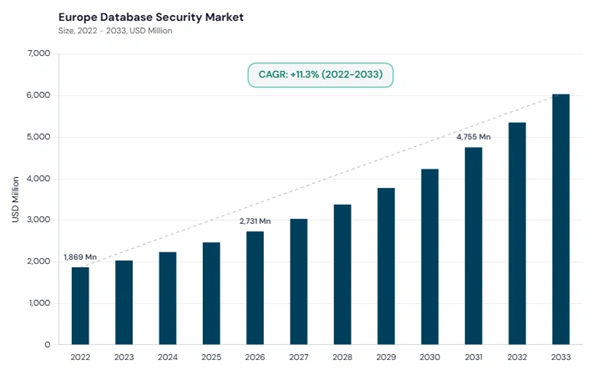
The Europe Database Security Market is expected to witness market growth of 12.0% CAGR during the forecast period (2026-2033) and is expected to attain a market size of USD 4.75 Billion by 2031.
Germany dominated the Europe Database Security Market by country in 2025 and is expected to reach $1.03 Billion by 2032. Germany and the UK accounted for 21.1% and 18.8% of regional revenue in 2025. The UK is expected to witness a CAGR of 10.9% during 2026-2033, France 12.9%, and Spain 13.7%, showing a large western European base with stronger growth in selected follow-on markets.
Europe’s market grew alongside the region’s broader digitalization cycle, but it has been shaped more directly than most by data protection and sovereignty requirements. Early adoption centered on encryption and access controls for traditional database systems, then expanded toward data-centric security, monitoring, and advanced identity controls as cloud usage and regulatory scrutiny increased. GDPR and adjacent cyber rules changed database security from an operational safeguard into a governance-heavy discipline with clear audit and reporting expectations. That shift encouraged demand for integrated platforms that combine protection, visibility, and compliance readiness across mixed infrastructure environments.
The regional market is being shaped by rising regulatory complexity, wider use of AI and machine learning for anomaly detection, and the spread of hybrid and multi-cloud operating models. European buyers increasingly want automated compliance controls built into the platform rather than layered on later. They also need protections that can operate consistently across on-premise and cloud databases without losing transparency or policy control. As a result, vendors are emphasizing adaptable architectures, explainable analytics, and strong integration with identity, governance, and reporting workflows.
Germany dominated the Europe Database Security Market by country in 2025 and is expected to reach $1.03 Billion by 2032. Germany and the UK accounted for 21.1% and 18.8% of regional revenue in 2025. The UK is expected to witness a CAGR of 10.9% during 2026-2033, France 12.9%, and Spain 13.7%, showing a large western European base with stronger growth in selected follow-on markets.
Europe’s market grew alongside the region’s broader digitalization cycle, but it has been shaped more directly than most by data protection and sovereignty requirements. Early adoption centered on encryption and access controls for traditional database systems, then expanded toward data-centric security, monitoring, and advanced identity controls as cloud usage and regulatory scrutiny increased. GDPR and adjacent cyber rules changed database security from an operational safeguard into a governance-heavy discipline with clear audit and reporting expectations. That shift encouraged demand for integrated platforms that combine protection, visibility, and compliance readiness across mixed infrastructure environments.
The regional market is being shaped by rising regulatory complexity, wider use of AI and machine learning for anomaly detection, and the spread of hybrid and multi-cloud operating models. European buyers increasingly want automated compliance controls built into the platform rather than layered on later. They also need protections that can operate consistently across on-premise and cloud databases without losing transparency or policy control. As a result, vendors are emphasizing adaptable architectures, explainable analytics, and strong integration with identity, governance, and reporting workflows.
Deployment Mode Outlook
Cloud dominated the market in 2025 and is expected to reach $2.77 Billion by 2032, growing at a CAGR of 12.1%. On-Premise is projected to grow at 11.8% and remains important in sectors that prioritize data sovereignty, internal control, and heavy compliance assurance. Europe still leans toward cloud expansion, but deployment decisions remain closely tied to regulatory interpretation and sector-specific sensitivity around data location.Solution Type Outlook
Data Encryption, Tokenization & Masking dominated the market and is expected to reach $1.60 Billion by 2033, growing at a CAGR of 11.0%. Access Control & Authorization is expected to grow the fastest at 12.8%, while Database Activity Monitoring & Auditing remains widely used in accountability-focused environments. This balance reflects Europe’s preference for privacy-first controls that can also support strong identity governance and audit readiness.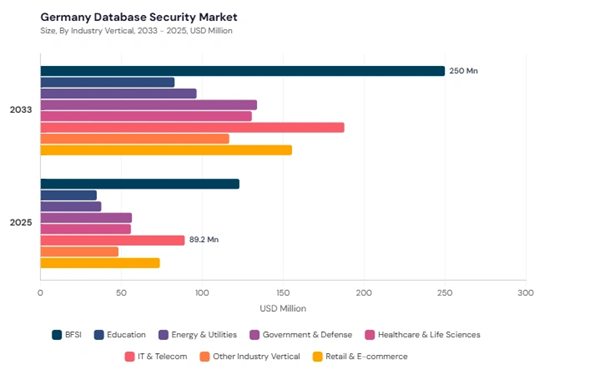
Industry Vertical Outlook
BFSI dominated the market and is expected to reach $1.09 Billion by 2031, growing at a CAGR of 10.8%. Retail & E-commerce is expected to record the fastest growth at 11.1%, and IT & Telecom continues to represent another major demand layer at 11.3% CAGR. Financial data protection and regulatory scrutiny keep BFSI in the lead, while digital commerce and telecom infrastructure continue widening the regional need for scalable database safeguards.Organization Size Outlook
Large Enterprises dominated the market and are expected to reach $3.71 million by 2033, growing at a CAGR of 11.6%. SMEs are projected to grow faster at 12.7% as cloud-based controls and compliance-focused platforms become more accessible. Larger organizations still lead because they face heavier governance burdens, operate across more jurisdictions, and manage more complex database estates.Country Outlook
Germany remains the focal country for the region because it combines industrial-scale data usage, strong enterprise software adoption, and demanding privacy expectations. Database security in Germany is increasingly tied to cloud migration, hybrid infrastructure, and compliance-heavy identity and access management practices. Buyers are placing greater emphasis on zero-trust models, adaptive analytics, and automated auditability. The market also reflects Germany’s larger role in enterprise digital transformation and regulated data handling. That makes it a strong proxy for how Europe is balancing technological modernization with strict governance and localization requirements.List of Key Companies Profiled
- Oracle Corporation
- IBM Corporation
- Microsoft Corporation
- Thales Group S.A.
- Fortinet, Inc.
- McAfee, LLC
- SAP SE
- OpenText Corporation
- Cisco Systems, Inc.
- Huawei Technologies Co., Ltd.
Market Report Segmentation
By Deployment Mode- Cloud
- On-Premise
- Data Encryption, Tokenization & Masking
- Database Activity Monitoring & Auditing
- Access Control & Authorization
- Data Security Analytics
- Data Governance & Compliance
- Backup & Recovery
- Data Discovery & Classification
- Large Enterprises
- Small & Medium-sized Enterprises (SMEs)
- BFSI
- IT & Telecom
- Retail & E-commerce
- Government & Defense
- Healthcare & Life Sciences
- Energy & Utilities
- Education
- Other Industry Vertical
- Germany
- UK
- France
- Russia
- Spain
- Italy
- Rest of Europe
Table of Contents
Chapter 1. Europe Market1.1 Market Overview
1.2 Key Factors Impacting Market
1.2.1 Market Drivers
1.2.2 Market Restraints
1.2.3 Market Opportunities
1.2.4 Market Challenges
1.2.5 Market Trends
1.2.6 State of Competition
1.2.7 Market Consolidation
1.2.8 Key Customer Criteria
1.3 Product Life Cycle
1.4 Segmentation By Deployment Mode
1.4.1 Cloud
1.4.2 On-Premise
1.5 Segmentation By Organization Size
1.5.1 Large Enterprises
1.5.2 Small & Medium-sized Enterprises (SMEs)
1.6 Segmentation By Solution Type
1.6.1 Data Discovery & Classification
1.6.2 Data Encryption, Tokenization & Masking
1.6.3 Database Activity Monitoring & Auditing
1.6.4 Access Control & Authorization
1.6.5 Data Security Analytics
1.6.6 Backup & Recovery
1.6.7 Data Governance & Compliance
1.7 Segmentation By Industry Vertical
1.7.1 BFSI
1.7.2 IT & Telecom
1.7.3 Retail & E-commerce
1.7.4 Government & Defense
1.7.5 Healthcare & Life Sciences
1.7.6 Energy & Utilities
1.7.7 Education
1.7.8 Other Industry Vertical
1.8 Segmentation By Country
1.8.1 Germany
1.8.1.1 Segmentation By Deployment Mode
1.8.1.1.1 Cloud
1.8.1.1.2 On-Premise
1.8.1.2 Segmentation By Organization Size
1.8.1.2.1 Large Enterprises
1.8.1.2.2 Small & Medium-sized Enterprises (SMEs)
1.8.1.3 Segmentation By Solution Type
1.8.1.3.1 Data Discovery & Classification
1.8.1.3.2 Data Encryption, Tokenization & Masking
1.8.1.3.3 Database Activity Monitoring & Auditing
1.8.1.3.4 Access Control & Authorization
1.8.1.3.5 Data Security Analytics
1.8.1.3.6 Backup & Recovery
1.8.1.3.7 Data Governance & Compliance
1.8.1.4 Segmentation By Industry Vertical
1.8.1.4.1 BFSI
1.8.1.4.2 IT & Telecom
1.8.1.4.3 Retail & E-commerce
1.8.1.4.4 Government & Defense
1.8.1.4.5 Healthcare & Life Sciences
1.8.1.4.6 Energy & Utilities
1.8.1.4.7 Education
1.8.1.4.8 Other Industry Vertical
1.8.2 UK
1.8.2.1 Segmentation By Deployment Mode
1.8.2.1.1 Cloud
1.8.2.1.2 On-Premise
1.8.2.2 Segmentation By Organization Size
1.8.2.2.1 Large Enterprises
1.8.2.2.2 Small & Medium-sized Enterprises (SMEs)
1.8.2.3 Segmentation By Solution Type
1.8.2.3.1 Data Discovery & Classification
1.8.2.3.2 Data Encryption, Tokenization & Masking
1.8.2.3.3 Database Activity Monitoring & Auditing
1.8.2.3.4 Access Control & Authorization
1.8.2.3.5 Data Security Analytics
1.8.2.3.6 Backup & Recovery
1.8.2.3.7 Data Governance & Compliance
1.8.2.4 Segmentation By Industry Vertical
1.8.2.4.1 BFSI
1.8.2.4.2 IT & Telecom
1.8.2.4.3 Retail & E-commerce
1.8.2.4.4 Government & Defense
1.8.2.4.5 Healthcare & Life Sciences
1.8.2.4.6 Energy & Utilities
1.8.2.4.7 Education
1.8.2.4.8 Other Industry Vertical
1.8.3 France
1.8.3.1 Segmentation By Deployment Mode
1.8.3.1.1 Cloud
1.8.3.1.2 On-Premise
1.8.3.2 Segmentation By Organization Size
1.8.3.2.1 Large Enterprises
1.8.3.2.2 Small & Medium-sized Enterprises (SMEs)
1.8.3.3 Segmentation By Solution Type
1.8.3.3.1 Data Discovery & Classification
1.8.3.3.2 Data Encryption, Tokenization & Masking
1.8.3.3.3 Database Activity Monitoring & Auditing
1.8.3.3.4 Access Control & Authorization
1.8.3.3.5 Data Security Analytics
1.8.3.3.6 Backup & Recovery
1.8.3.3.7 Data Governance & Compliance
1.8.3.4 Segmentation By Industry Vertical
1.8.3.4.1 BFSI
1.8.3.4.2 IT & Telecom
1.8.3.4.3 Retail & E-commerce
1.8.3.4.4 Government & Defense
1.8.3.4.5 Healthcare & Life Sciences
1.8.3.4.6 Energy & Utilities
1.8.3.4.7 Education
1.8.3.4.8 Other Industry Vertical
1.8.4 Russia
1.8.4.1 Segmentation By Deployment Mode
1.8.4.1.1 Cloud
1.8.4.1.2 On-Premise
1.8.4.2 Segmentation By Organization Size
1.8.4.2.1 Large Enterprises
1.8.4.2.2 Small & Medium-sized Enterprises (SMEs)
1.8.4.3 Segmentation By Solution Type
1.8.4.3.1 Data Discovery & Classification
1.8.4.3.2 Data Encryption, Tokenization & Masking
1.8.4.3.3 Database Activity Monitoring & Auditing
1.8.4.3.4 Access Control & Authorization
1.8.4.3.5 Data Security Analytics
1.8.4.3.6 Backup & Recovery
1.8.4.3.7 Data Governance & Compliance
1.8.4.4 Segmentation By Industry Vertical
1.8.4.4.1 BFSI
1.8.4.4.2 IT & Telecom
1.8.4.4.3 Retail & E-commerce
1.8.4.4.4 Government & Defense
1.8.4.4.5 Healthcare & Life Sciences
1.8.4.4.6 Energy & Utilities
1.8.4.4.7 Education
1.8.4.4.8 Other Industry Vertical
1.8.5 Spain
1.8.5.1 Segmentation By Deployment Mode
1.8.5.1.1 Cloud
1.8.5.1.2 On-Premise
1.8.5.2 Segmentation By Organization Size
1.8.5.2.1 Large Enterprises
1.8.5.2.2 Small & Medium-sized Enterprises (SMEs)
1.8.5.3 Segmentation By Solution Type
1.8.5.3.1 Data Discovery & Classification
1.8.5.3.2 Data Encryption, Tokenization & Masking
1.8.5.3.3 Database Activity Monitoring & Auditing
1.8.5.3.4 Access Control & Authorization
1.8.5.3.5 Data Security Analytics
1.8.5.3.6 Backup & Recovery
1.8.5.3.7 Data Governance & Compliance
1.8.5.4 Segmentation By Industry Vertical
1.8.5.4.1 BFSI
1.8.5.4.2 IT & Telecom
1.8.5.4.3 Retail & E-commerce
1.8.5.4.4 Government & Defense
1.8.5.4.5 Healthcare & Life Sciences
1.8.5.4.6 Energy & Utilities
1.8.5.4.7 Education
1.8.5.4.8 Other Industry Vertical
1.8.6 Italy
1.8.6.1 Segmentation By Deployment Mode
1.8.6.1.1 Cloud
1.8.6.1.2 On-Premise
1.8.6.2 Segmentation By Organization Size
1.8.6.2.1 Large Enterprises
1.8.6.2.2 Small & Medium-sized Enterprises (SMEs)
1.8.6.3 Segmentation By Solution Type
1.8.6.3.1 Data Discovery & Classification
1.8.6.3.2 Data Encryption, Tokenization & Masking
1.8.6.3.3 Database Activity Monitoring & Auditing
1.8.6.3.4 Access Control & Authorization
1.8.6.3.5 Data Security Analytics
1.8.6.3.6 Backup & Recovery
1.8.6.3.7 Data Governance & Compliance
1.8.6.4 Segmentation By Industry Vertical
1.8.6.4.1 BFSI
1.8.6.4.2 IT & Telecom
1.8.6.4.3 Retail & E-commerce
1.8.6.4.4 Government & Defense
1.8.6.4.5 Healthcare & Life Sciences
1.8.6.4.6 Energy & Utilities
1.8.6.4.7 Education
1.8.6.4.8 Other Industry Vertical
1.8.7 Rest of Europe
1.8.7.1 Segmentation By Deployment Mode
1.8.7.1.1 Cloud
1.8.7.1.2 On-Premise
1.8.7.2 Segmentation By Organization Size
1.8.7.2.1 Large Enterprises
1.8.7.2.2 Small & Medium-sized Enterprises (SMEs)
1.8.7.3 Segmentation By Solution Type
1.8.7.3.1 Data Discovery & Classification
1.8.7.3.2 Data Encryption, Tokenization & Masking
1.8.7.3.3 Database Activity Monitoring & Auditing
1.8.7.3.4 Access Control & Authorization
1.8.7.3.5 Data Security Analytics
1.8.7.3.6 Backup & Recovery
1.8.7.3.7 Data Governance & Compliance
1.8.7.4 Segmentation By Industry Vertical
1.8.7.4.1 BFSI
1.8.7.4.2 IT & Telecom
1.8.7.4.3 Retail & E-commerce
1.8.7.4.4 Government & Defense
1.8.7.4.5 Healthcare & Life Sciences
1.8.7.4.6 Energy & Utilities
1.8.7.4.7 Education
1.8.7.4.8 Other Industry Vertical
Chapter 2. Company Snapshot
2.1 IBM Corporation
2.1.1 Business Overview
2.1.2 Key Information
2.1.3 Company Focus
2.1.4 Strategic Insights
2.1.5 Strategy Deployed
2.1.6 Product & Service Portfolio
2.1.7 Capability Overview
2.1.8 Technology & Innovation Focus
2.1.9 Customers / End Users
2.1.10 Competitive Positioning
2.1.11 Key Differentiators
2.1.12 Portfolio Matrix
2.1.13 SWOT Analysis
2.1.14 Future Outlook
2.2 Oracle Corporation
2.2.1 Business Overview
2.2.2 Key Information
2.2.3 Company Focus
2.2.4 Strategic Insights
2.2.5 Strategy Deployed
2.2.6 Product & Service Portfolio
2.2.7 Capability Overview
2.2.8 Technology & Innovation Focus
2.2.9 Customers / End Users
2.2.10 Competitive Positioning
2.2.11 Key Differentiators
2.2.12 Portfolio Matrix
2.2.13 SWOT Analysis
2.2.14 Future Outlook
2.3 Microsoft Corporation
2.3.1 Business Overview
2.3.2 Key Information
2.3.3 Company Focus
2.3.4 Strategic Insights
2.3.5 Strategy Deployed
2.3.6 Product & Service Portfolio
2.3.7 Capability Overview
2.3.8 Technology & Innovation Focus
2.3.9 Customers / End Users
2.3.10 Competitive Positioning
2.3.11 Key Differentiators
2.3.12 Portfolio Matrix
2.3.13 SWOT Analysis
2.3.14 Future Outlook
2.4 McAfee Corp.
2.4.1 Business Overview
2.4.2 Key Information
2.4.3 Company Focus
2.4.4 Strategic Insights
2.4.5 Strategy Deployed
2.4.6 Product & Service Portfolio
2.4.7 Capability Overview
2.4.8 Technology & Innovation Focus
2.4.9 Customers / End Users
2.4.10 Competitive Positioning
2.4.11 Key Differentiators
2.4.12 Portfolio Matrix
2.4.13 SWOT Analysis
2.4.14 Future Outlook
2.5 Fortinet, Inc.
2.5.1 Business Overview
2.5.2 Key Information
2.5.3 Company Focus
2.5.4 Strategic Insights
2.5.5 Strategy Deployed
2.5.6 Product & Service Portfolio
2.5.7 Capability Overview
2.5.8 Technology & Innovation Focus
2.5.9 Customers / End Users
2.5.10 Competitive Positioning
2.5.11 Key Differentiators
2.5.12 Portfolio Matrix
2.5.13 SWOT Analysis
2.5.14 Future Outlook
2.6 Thales Group S.A.
2.6.1 Business Overview
2.6.2 Key Information
2.6.3 Company Focus
2.6.4 Strategic Insights
2.6.5 Strategy Deployed
2.6.6 Product & Service Portfolio
2.6.7 Capability Overview
2.6.8 Technology & Innovation Focus
2.6.9 Customers / End Users
2.6.10 Competitive Positioning
2.6.11 Key Differentiators
2.6.12 Portfolio Matrix
2.6.13 SWOT Analysis
2.6.14 Future Outlook
2.7 SAP SE
2.7.1 Business Overview
2.7.2 Key Information
2.7.3 Company Focus
2.7.4 Strategic Insights
2.7.5 Strategy Deployed
2.7.6 Product & Service Portfolio
2.7.7 Capability Overview
2.7.8 Technology & Innovation Focus
2.7.9 Customers / End Users
2.7.10 Competitive Positioning
2.7.11 Key Differentiators
2.7.12 Portfolio Matrix
2.7.13 SWOT Analysis
2.7.14 Future Outlook
2.8 Open Text Corporation
2.8.1 Business Overview
2.8.2 Key Information
2.8.3 Company Focus
2.8.4 Strategic Insights
2.8.5 Strategy Deployed
2.8.6 Product & Service Portfolio
2.8.7 Capability Overview
2.8.8 Technology & Innovation Focus
2.8.9 Customers / End Users
2.8.10 Competitive Positioning
2.8.11 Key Differentiators
2.8.12 Portfolio Matrix
2.8.13 SWOT Analysis
2.8.14 Future Outlook
2.9 Cisco Systems, Inc.
2.9.1 Business Overview
2.9.2 Key Information
2.9.3 Company Focus
2.9.4 Strategic Insights
2.9.5 Strategy Deployed
2.9.6 Product & Service Portfolio
2.9.7 Capability Overview
2.9.8 Technology & Innovation Focus
2.9.9 Customers / End Users
2.9.10 Competitive Positioning
2.9.11 Key Differentiators
2.9.12 Portfolio Matrix
2.9.13 SWOT Analysis
2.9.14 Future Outlook
2.10 Huawei Technologies Co., Ltd. (Huawei Investment & Holding Co., Ltd.)
2.10.1 Business Overview
2.10.2 Key Information
2.10.3 Company Focus
2.10.4 Strategic Insights
2.10.5 Strategy Deployed
2.10.6 Product & Service Portfolio
2.10.7 Capability Overview
2.10.8 Technology & Innovation Focus
2.10.9 Customers / End Users
2.10.10 Competitive Positioning
2.10.11 Key Differentiators
2.10.12 Portfolio Matrix
2.10.13 SWOT Analysis
2.10.14 Future Outlook
Companies Mentioned
- Oracle Corporation
- IBM Corporation
- Microsoft Corporation
- Thales Group S.A.
- Fortinet, Inc.
- McAfee, LLC
- SAP SE
- OpenText Corporation
- Cisco Systems, Inc.
- Huawei Technologies Co., Ltd.


