



The Asia Pacific Database Security Market is expected to witness market growth of 13.1% CAGR during the forecast period (2026-2033) and would reach a market value of USD 3.83 Billion by 2030.
China dominated the Asia Pacific Database Security Market by country in 2025 and is expected to reach $1.46 Billion by 2033. China and Japan accounted for 29.9% and 18.2% of regional revenue in 2025. Japan is expected to witness a CAGR of 12.4% during 2026-2033, India 14.0%, and Singapore 14.9%, showing that the region’s growth remains broad beyond the two current leaders.
Asia Pacific’s market has expanded quickly as governments and enterprises pushed digital transformation, cloud adoption, and large-scale data modernization across varied national environments. Early protections were often basic and perimeter-led, but the rise of big data, cloud computing, and stricter cybersecurity expectations increased demand for more integrated controls. National data governance rules, high growth in digital commerce, and rapid IT buildouts created a market where database protection now spans encryption, behavioral analytics, monitoring, and access governance. The region has therefore moved from reactive security toward more proactive and integrated database risk management.
Three forces stand out in the region: tighter national cybersecurity requirements, broader use of AI and machine learning in threat detection, and the spread of hybrid and multi-cloud architectures. Buyers increasingly want database security tools that support traceability, compliance, and operational flexibility across mixed infrastructure. Cost efficiency and localization also matter more here than in some mature markets, so vendors compete on scalability, integration, and regional fit. This creates a market where innovation is advancing quickly, but deployment strategy still has to adapt to very different national conditions.
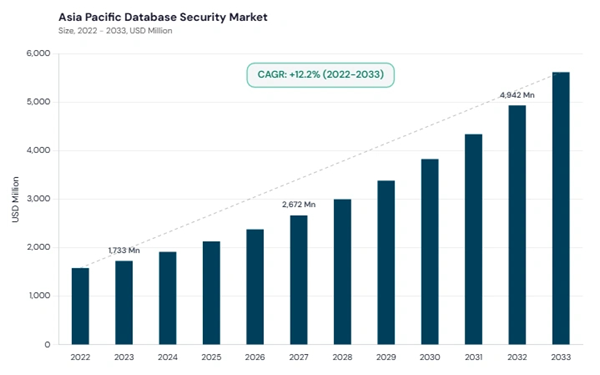
China dominated the Asia Pacific Database Security Market by country in 2025 and is expected to reach $1.46 Billion by 2033. China and Japan accounted for 29.9% and 18.2% of regional revenue in 2025. Japan is expected to witness a CAGR of 12.4% during 2026-2033, India 14.0%, and Singapore 14.9%, showing that the region’s growth remains broad beyond the two current leaders.
Asia Pacific’s market has expanded quickly as governments and enterprises pushed digital transformation, cloud adoption, and large-scale data modernization across varied national environments. Early protections were often basic and perimeter-led, but the rise of big data, cloud computing, and stricter cybersecurity expectations increased demand for more integrated controls. National data governance rules, high growth in digital commerce, and rapid IT buildouts created a market where database protection now spans encryption, behavioral analytics, monitoring, and access governance. The region has therefore moved from reactive security toward more proactive and integrated database risk management.
Three forces stand out in the region: tighter national cybersecurity requirements, broader use of AI and machine learning in threat detection, and the spread of hybrid and multi-cloud architectures. Buyers increasingly want database security tools that support traceability, compliance, and operational flexibility across mixed infrastructure. Cost efficiency and localization also matter more here than in some mature markets, so vendors compete on scalability, integration, and regional fit. This creates a market where innovation is advancing quickly, but deployment strategy still has to adapt to very different national conditions.
Deployment Mode Outlook
Cloud dominated the market in 2025 and is expected to reach $2.92 Billion by 2033, growing at a CAGR of 13.2%. On-Premise is expected to grow at 12.9%, but the regional direction favors cloud because organizations want scalability, faster deployment, and support for distributed digital operations. That shift is especially strong in fast-modernizing sectors that need to secure high-volume data flows across several platforms at once.Solution Type Outlook
Data Encryption, Tokenization & Masking dominated the market and is expected to reach $1.49 Billion by 2033, growing at a CAGR of 12.0%. Access Control & Authorization is projected to grow the fastest at 13.9%, while Database Activity Monitoring & Auditing remains another large layer of demand. This mix reflects the region’s need for both strong foundational data protection and more dynamic identity-led control models as infrastructure becomes more distributed.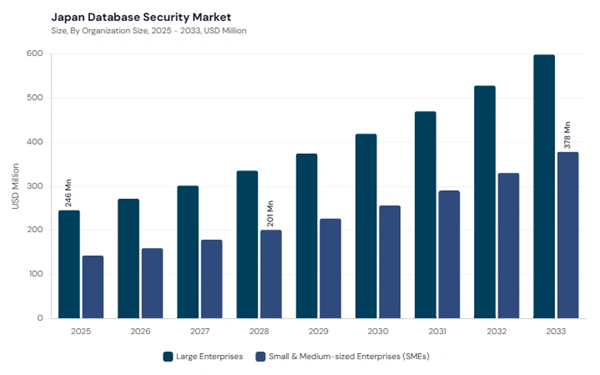
Industry Vertical Outlook
BFSI dominated the market and is expected to reach $1.26 Billion by 2033, growing at a CAGR of 11.9%. Retail & E-commerce is expected to post the fastest growth at 12.2%, while IT & Telecom remains another major adopter at 12.3% CAGR. Sensitive financial data keeps BFSI in the lead, but digital retail growth, mobile commerce, and platform-driven ecosystems are steadily widening the security spending base.Organization Size Outlook
Large Enterprises dominated the market and are expected to reach $3.46 Billion by 2033, growing at a CAGR of 12.6%. SMEs are projected to grow faster at 13.8% as cloud-native platforms, managed services, and modular protection tools improve affordability. Large enterprises still lead because they operate bigger data infrastructures, broader compliance footprints, and more complex hybrid environments.Country Outlook
China remains the key country outlook because it sits at the intersection of large-scale digital infrastructure, strong state-backed cybersecurity expectations, and fast-moving enterprise modernization. Organizations are increasingly deploying integrated security ecosystems that combine compliance controls, encryption, activity analytics, and adaptive access management. Hybrid cloud and data sovereignty pressures are also reshaping buying behavior, pushing vendors to deliver stronger interoperability and auditability. China’s competitive environment mixes local adaptation with advanced AI-driven protection models, making it one of the most strategically important markets in the region. That scale and pace of change keep China at the center of Asia Pacific database security demand.List of Key Companies Profiled
- Oracle Corporation
- IBM Corporation
- Microsoft Corporation
- Thales Group S.A.
- Fortinet, Inc.
- McAfee, LLC
- SAP SE
- OpenText Corporation
- Cisco Systems, Inc.
- Huawei Technologies Co., Ltd.
Market Report Segmentation
By Deployment Mode- Cloud
- On-Premise
- Data Encryption, Tokenization & Masking
- Database Activity Monitoring & Auditing
- Access Control & Authorization
- Data Security Analytics
- Data Governance & Compliance
- Backup & Recovery
- Data Discovery & Classification
- Large Enterprises
- Small & Medium-sized Enterprises (SMEs)
- BFSI
- IT & Telecom
- Retail & E-commerce
- Government & Defense
- Healthcare & Life Sciences
- Energy & Utilities
- Education
- Other Industry Vertical
- China
- Japan
- India
- South Korea
- Singapore
- Malaysia
- Rest of Asia Pacific
Table of Contents
Chapter 1. Asia Pacific Market1.1 Market Overview
1.2 Key Factors Impacting Market
1.2.1 Market Drivers
1.2.2 Market Restraints
1.2.3 Market Opportunities
1.2.4 Market Challenges
1.2.5 Market Trends
1.2.6 State of Competition
1.2.7 Market Consolidation
1.2.8 Key Customer Criteria
1.3 Product Life Cycle
1.4 Segmentation By Deployment Mode
1.4.1 Cloud
1.4.2 On-Premise
1.5 Segmentation By Organization Size
1.5.1 Large Enterprises
1.5.2 Small & Medium-sized Enterprises (SMEs)
1.6 Segmentation By Solution Type
1.6.1 Data Discovery & Classification
1.6.2 Data Encryption, Tokenization & Masking
1.6.3 Database Activity Monitoring & Auditing
1.6.4 Access Control & Authorization
1.6.5 Data Security Analytics
1.6.6 Backup & Recovery
1.6.7 Data Governance & Compliance
1.7 Segmentation By Industry Vertical
1.7.1 BFSI
1.7.2 IT & Telecom
1.7.3 Retail & E-commerce
1.7.4 Government & Defense
1.7.5 Healthcare & Life Sciences
1.7.6 Energy & Utilities
1.7.7 Education
1.7.8 Other Industry Vertical
1.8 Segmentation By Country
1.8.1 China
1.8.1.1 Segmentation By Deployment Mode
1.8.1.1.1 Cloud
1.8.1.1.2 On-Premise
1.8.1.2 Segmentation By Organization Size
1.8.1.2.1 Large Enterprises
1.8.1.2.2 Small & Medium-sized Enterprises (SMEs)
1.8.1.3 Segmentation By Solution Type
1.8.1.3.1 Data Discovery & Classification
1.8.1.3.2 Data Encryption, Tokenization & Masking
1.8.1.3.3 Database Activity Monitoring & Auditing
1.8.1.3.4 Access Control & Authorization
1.8.1.3.5 Data Security Analytics
1.8.1.3.6 Backup & Recovery
1.8.1.3.7 Data Governance & Compliance
1.8.1.4 Segmentation By Industry Vertical
1.8.1.4.1 BFSI
1.8.1.4.2 IT & Telecom
1.8.1.4.3 Retail & E-commerce
1.8.1.4.4 Government & Defense
1.8.1.4.5 Healthcare & Life Sciences
1.8.1.4.6 Energy & Utilities
1.8.1.4.7 Education
1.8.1.4.8 Other Industry Vertical
1.8.2 Japan
1.8.2.1 Segmentation By Deployment Mode
1.8.2.1.1 Cloud
1.8.2.1.2 On-Premise
1.8.2.2 Segmentation By Organization Size
1.8.2.2.1 Large Enterprises
1.8.2.2.2 Small & Medium-sized Enterprises (SMEs)
1.8.2.3 Segmentation By Solution Type
1.8.2.3.1 Data Discovery & Classification
1.8.2.3.2 Data Encryption, Tokenization & Masking
1.8.2.3.3 Database Activity Monitoring & Auditing
1.8.2.3.4 Access Control & Authorization
1.8.2.3.5 Data Security Analytics
1.8.2.3.6 Backup & Recovery
1.8.2.3.7 Data Governance & Compliance
1.8.2.4 Segmentation By Industry Vertical
1.8.2.4.1 BFSI
1.8.2.4.2 IT & Telecom
1.8.2.4.3 Retail & E-commerce
1.8.2.4.4 Government & Defense
1.8.2.4.5 Healthcare & Life Sciences
1.8.2.4.6 Energy & Utilities
1.8.2.4.7 Education
1.8.2.4.8 Other Industry Vertical
1.8.3 India
1.8.3.1 Segmentation By Deployment Mode
1.8.3.1.1 Cloud
1.8.3.1.2 On-Premise
1.8.3.2 Segmentation By Organization Size
1.8.3.2.1 Large Enterprises
1.8.3.2.2 Small & Medium-sized Enterprises (SMEs)
1.8.3.3 Segmentation By Solution Type
1.8.3.3.1 Data Discovery & Classification
1.8.3.3.2 Data Encryption, Tokenization & Masking
1.8.3.3.3 Database Activity Monitoring & Auditing
1.8.3.3.4 Access Control & Authorization
1.8.3.3.5 Data Security Analytics
1.8.3.3.6 Backup & Recovery
1.8.3.3.7 Data Governance & Compliance
1.8.3.4 Segmentation By Industry Vertical
1.8.3.4.1 BFSI
1.8.3.4.2 IT & Telecom
1.8.3.4.3 Retail & E-commerce
1.8.3.4.4 Government & Defense
1.8.3.4.5 Healthcare & Life Sciences
1.8.3.4.6 Energy & Utilities
1.8.3.4.7 Education
1.8.3.4.8 Other Industry Vertical
1.8.4 South Korea
1.8.4.1 Segmentation By Deployment Mode
1.8.4.1.1 Cloud
1.8.4.1.2 On-Premise
1.8.4.2 Segmentation By Organization Size
1.8.4.2.1 Large Enterprises
1.8.4.2.2 Small & Medium-sized Enterprises (SMEs)
1.8.4.3 Segmentation By Solution Type
1.8.4.3.1 Data Discovery & Classification
1.8.4.3.2 Data Encryption, Tokenization & Masking
1.8.4.3.3 Database Activity Monitoring & Auditing
1.8.4.3.4 Access Control & Authorization
1.8.4.3.5 Data Security Analytics
1.8.4.3.6 Backup & Recovery
1.8.4.3.7 Data Governance & Compliance
1.8.4.4 Segmentation By Industry Vertical
1.8.4.4.1 BFSI
1.8.4.4.2 IT & Telecom
1.8.4.4.3 Retail & E-commerce
1.8.4.4.4 Government & Defense
1.8.4.4.5 Healthcare & Life Sciences
1.8.4.4.6 Energy & Utilities
1.8.4.4.7 Education
1.8.4.4.8 Other Industry Vertical
1.8.5 Singapore
1.8.5.1 Segmentation By Deployment Mode
1.8.5.1.1 Cloud
1.8.5.1.2 On-Premise
1.8.5.2 Segmentation By Organization Size
1.8.5.2.1 Large Enterprises
1.8.5.2.2 Small & Medium-sized Enterprises (SMEs)
1.8.5.3 Segmentation By Solution Type
1.8.5.3.1 Data Discovery & Classification
1.8.5.3.2 Data Encryption, Tokenization & Masking
1.8.5.3.3 Database Activity Monitoring & Auditing
1.8.5.3.4 Access Control & Authorization
1.8.5.3.5 Data Security Analytics
1.8.5.3.6 Backup & Recovery
1.8.5.3.7 Data Governance & Compliance
1.8.5.4 Segmentation By Industry Vertical
1.8.5.4.1 BFSI
1.8.5.4.2 IT & Telecom
1.8.5.4.3 Retail & E-commerce
1.8.5.4.4 Government & Defense
1.8.5.4.5 Healthcare & Life Sciences
1.8.5.4.6 Energy & Utilities
1.8.5.4.7 Education
1.8.5.4.8 Other Industry Vertical
1.8.6 Malaysia
1.8.6.1 Segmentation By Deployment Mode
1.8.6.1.1 Cloud
1.8.6.1.2 On-Premise
1.8.6.2 Segmentation By Organization Size
1.8.6.2.1 Large Enterprises
1.8.6.2.2 Small & Medium-sized Enterprises (SMEs)
1.8.6.3 Segmentation By Solution Type
1.8.6.3.1 Data Discovery & Classification
1.8.6.3.2 Data Encryption, Tokenization & Masking
1.8.6.3.3 Database Activity Monitoring & Auditing
1.8.6.3.4 Access Control & Authorization
1.8.6.3.5 Data Security Analytics
1.8.6.3.6 Backup & Recovery
1.8.6.3.7 Data Governance & Compliance
1.8.6.4 Segmentation By Industry Vertical
1.8.6.4.1 BFSI
1.8.6.4.2 IT & Telecom
1.8.6.4.3 Retail & E-commerce
1.8.6.4.4 Government & Defense
1.8.6.4.5 Healthcare & Life Sciences
1.8.6.4.6 Energy & Utilities
1.8.6.4.7 Education
1.8.6.4.8 Other Industry Vertical
1.8.7 Rest of Asia Pacific
1.8.7.1 Segmentation By Deployment Mode
1.8.7.1.1 Cloud
1.8.7.1.2 On-Premise
1.8.7.2 Segmentation By Organization Size
1.8.7.2.1 Large Enterprises
1.8.7.2.2 Small & Medium-sized Enterprises (SMEs)
1.8.7.3 Segmentation By Solution Type
1.8.7.3.1 Data Discovery & Classification
1.8.7.3.2 Data Encryption, Tokenization & Masking
1.8.7.3.3 Database Activity Monitoring & Auditing
1.8.7.3.4 Access Control & Authorization
1.8.7.3.5 Data Security Analytics
1.8.7.3.6 Backup & Recovery
1.8.7.3.7 Data Governance & Compliance
1.8.7.4 Segmentation By Industry Vertical
1.8.7.4.1 BFSI
1.8.7.4.2 IT & Telecom
1.8.7.4.3 Retail & E-commerce
1.8.7.4.4 Government & Defense
1.8.7.4.5 Healthcare & Life Sciences
1.8.7.4.6 Energy & Utilities
1.8.7.4.7 Education
1.8.7.4.8 Other Industry Vertical
Chapter 2. Company Snapshot
2.1 IBM Corporation
2.1.1 Business Overview
2.1.2 Key Information
2.1.3 Company Focus
2.1.4 Strategic Insights
2.1.5 Strategy Deployed
2.1.6 Product & Service Portfolio
2.1.7 Capability Overview
2.1.8 Technology & Innovation Focus
2.1.9 Customers / End Users
2.1.10 Competitive Positioning
2.1.11 Key Differentiators
2.1.12 Portfolio Matrix
2.1.13 SWOT Analysis
2.1.14 Future Outlook
2.2 Oracle Corporation
2.2.1 Business Overview
2.2.2 Key Information
2.2.3 Company Focus
2.2.4 Strategic Insights
2.2.5 Strategy Deployed
2.2.6 Product & Service Portfolio
2.2.7 Capability Overview
2.2.8 Technology & Innovation Focus
2.2.9 Customers / End Users
2.2.10 Competitive Positioning
2.2.11 Key Differentiators
2.2.12 Portfolio Matrix
2.2.13 SWOT Analysis
2.2.14 Future Outlook
2.3 Microsoft Corporation
2.3.1 Business Overview
2.3.2 Key Information
2.3.3 Company Focus
2.3.4 Strategic Insights
2.3.5 Strategy Deployed
2.3.6 Product & Service Portfolio
2.3.7 Capability Overview
2.3.8 Technology & Innovation Focus
2.3.9 Customers / End Users
2.3.10 Competitive Positioning
2.3.11 Key Differentiators
2.3.12 Portfolio Matrix
2.3.13 SWOT Analysis
2.3.14 Future Outlook
2.4 McAfee Corp.
2.4.1 Business Overview
2.4.2 Key Information
2.4.3 Company Focus
2.4.4 Strategic Insights
2.4.5 Strategy Deployed
2.4.6 Product & Service Portfolio
2.4.7 Capability Overview
2.4.8 Technology & Innovation Focus
2.4.9 Customers / End Users
2.4.10 Competitive Positioning
2.4.11 Key Differentiators
2.4.12 Portfolio Matrix
2.4.13 SWOT Analysis
2.4.14 Future Outlook
2.5 Fortinet, Inc.
2.5.1 Business Overview
2.5.2 Key Information
2.5.3 Company Focus
2.5.4 Strategic Insights
2.5.5 Strategy Deployed
2.5.6 Product & Service Portfolio
2.5.7 Capability Overview
2.5.8 Technology & Innovation Focus
2.5.9 Customers / End Users
2.5.10 Competitive Positioning
2.5.11 Key Differentiators
2.5.12 Portfolio Matrix
2.5.13 SWOT Analysis
2.5.14 Future Outlook
2.6 Thales Group S.A.
2.6.1 Business Overview
2.6.2 Key Information
2.6.3 Company Focus
2.6.4 Strategic Insights
2.6.5 Strategy Deployed
2.6.6 Product & Service Portfolio
2.6.7 Capability Overview
2.6.8 Technology & Innovation Focus
2.6.9 Customers / End Users
2.6.10 Competitive Positioning
2.6.11 Key Differentiators
2.6.12 Portfolio Matrix
2.6.13 SWOT Analysis
2.6.14 Future Outlook
2.7 SAP SE
2.7.1 Business Overview
2.7.2 Key Information
2.7.3 Company Focus
2.7.4 Strategic Insights
2.7.5 Strategy Deployed
2.7.6 Product & Service Portfolio
2.7.7 Capability Overview
2.7.8 Technology & Innovation Focus
2.7.9 Customers / End Users
2.7.10 Competitive Positioning
2.7.11 Key Differentiators
2.7.12 Portfolio Matrix
2.7.13 SWOT Analysis
2.7.14 Future Outlook
2.8 Open Text Corporation
2.8.1 Business Overview
2.8.2 Key Information
2.8.3 Company Focus
2.8.4 Strategic Insights
2.8.5 Strategy Deployed
2.8.6 Product & Service Portfolio
2.8.7 Capability Overview
2.8.8 Technology & Innovation Focus
2.8.9 Customers / End Users
2.8.10 Competitive Positioning
2.8.11 Key Differentiators
2.8.12 Portfolio Matrix
2.8.13 SWOT Analysis
2.8.14 Future Outlook
2.9 Cisco Systems, Inc.
2.9.1 Business Overview
2.9.2 Key Information
2.9.3 Company Focus
2.9.4 Strategic Insights
2.9.5 Strategy Deployed
2.9.6 Product & Service Portfolio
2.9.7 Capability Overview
2.9.8 Technology & Innovation Focus
2.9.9 Customers / End Users
2.9.10 Competitive Positioning
2.9.11 Key Differentiators
2.9.12 Portfolio Matrix
2.9.13 SWOT Analysis
2.9.14 Future Outlook
2.10 Huawei Technologies Co., Ltd. (Huawei Investment & Holding Co., Ltd.)
2.10.1 Business Overview
2.10.2 Key Information
2.10.3 Company Focus
2.10.4 Strategic Insights
2.10.5 Strategy Deployed
2.10.6 Product & Service Portfolio
2.10.7 Capability Overview
2.10.8 Technology & Innovation Focus
2.10.9 Customers / End Users
2.10.10 Competitive Positioning
2.10.11 Key Differentiators
2.10.12 Portfolio Matrix
2.10.13 SWOT Analysis
2.10.14 Future Outlook
Companies Mentioned
- Oracle Corporation
- IBM Corporation
- Microsoft Corporation
- Thales Group S.A.
- Fortinet, Inc.
- McAfee, LLC
- SAP SE
- OpenText Corporation
- Cisco Systems, Inc.
- Huawei Technologies Co., Ltd.


