



The LAMEA Database Security Market is expected to witness market growth of 14.3% CAGR during the forecast period (2026-2033) and is poised to reach $1.25 Billion by 2030.
Brazil dominated the LAMEA Database Security Market by country in 2025 and is expected to reach $370.8 million by 2033. Brazil and the UAE accounted for 21.8% and 12.8% of regional revenue in 2025. Argentina is expected to witness a CAGR of 15.0% during 2026-2033, and South Africa 15.4%, indicating a broadening growth profile across the region.
LAMEA’s database security market developed more gradually than other large regions, beginning with basic encryption and access controls inside financial institutions, government agencies, and large enterprises. As cyber threats intensified and digital adoption expanded, the market moved toward more advanced auditing, threat detection, and response systems. Data privacy and cybercrime legislation helped push buyers toward more formal database security programs, while cloud migration and AI-enabled monitoring raised expectations around scalability and continuous defense. The regional market now reflects a more mature mix of compliance-driven demand, cloud-led modernization, and growing investment in intelligence-based protection.
The market is being shaped by stronger cloud database security adoption, wider use of AI and machine learning for behavior analytics, and heavier regulatory focus on data protection and breach handling. Buyers are increasingly looking for solutions that combine real-time monitoring, encryption, and incident response with manageable deployment models. Localization remains important because operational conditions, regulatory expectations, and infrastructure maturity vary widely across the region. That pushes vendors to balance advanced functionality with flexibility, support depth, and price sensitivity.
Brazil dominated the LAMEA Database Security Market by country in 2025 and is expected to reach $370.8 million by 2033. Brazil and the UAE accounted for 21.8% and 12.8% of regional revenue in 2025. Argentina is expected to witness a CAGR of 15.0% during 2026-2033, and South Africa 15.4%, indicating a broadening growth profile across the region.
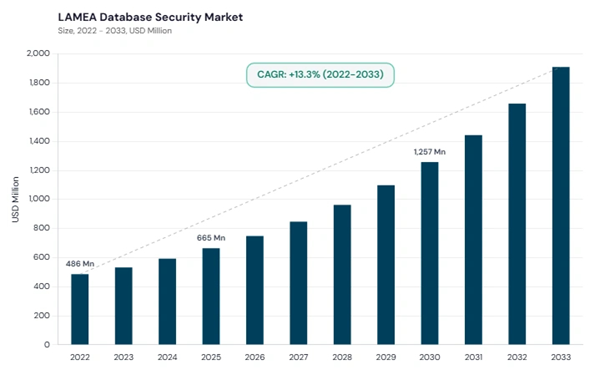
LAMEA’s database security market developed more gradually than other large regions, beginning with basic encryption and access controls inside financial institutions, government agencies, and large enterprises. As cyber threats intensified and digital adoption expanded, the market moved toward more advanced auditing, threat detection, and response systems. Data privacy and cybercrime legislation helped push buyers toward more formal database security programs, while cloud migration and AI-enabled monitoring raised expectations around scalability and continuous defense. The regional market now reflects a more mature mix of compliance-driven demand, cloud-led modernization, and growing investment in intelligence-based protection.
The market is being shaped by stronger cloud database security adoption, wider use of AI and machine learning for behavior analytics, and heavier regulatory focus on data protection and breach handling. Buyers are increasingly looking for solutions that combine real-time monitoring, encryption, and incident response with manageable deployment models. Localization remains important because operational conditions, regulatory expectations, and infrastructure maturity vary widely across the region. That pushes vendors to balance advanced functionality with flexibility, support depth, and price sensitivity.
Deployment Mode Outllook
Cloud dominated the market in 2025 and is expected to reach $1 Billion by 2033, growing at a CAGR of 14.5%. On-Premise is projected to grow at 14.2%, but cloud still carries the stronger outlook because it offers faster scaling and easier deployment for organizations modernizing under budget and infrastructure constraints. This keeps cloud-led security architectures at the center of regional expansion.Solution Type Outllook
Data Encryption, Tokenization & Masking dominated the market and is expected to reach $510.7 million by 2033, growing at a CAGR of 13.3%. Access Control & Authorization is expected to grow the fastest at 15.1%, while Database Activity Monitoring & Auditing also remains important in environments with rising threat exposure and tighter compliance needs. The regional mix still starts with foundational protection, but identity-sensitive controls are gaining ground faster.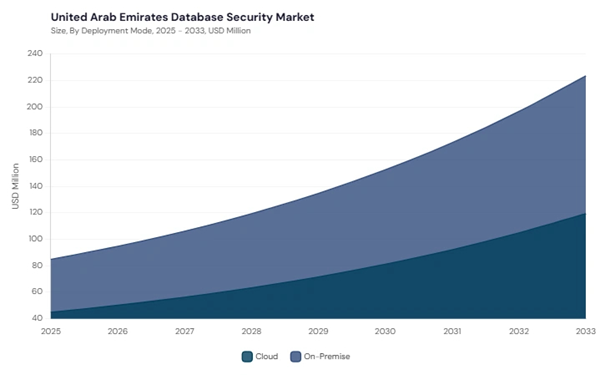
Industry Vertical Outllook
BFSI dominated the market and is expected to reach $433.1 million by 2033, growing at a CAGR of 13.1%. Retail & E-commerce is expected to post the fastest growth at 13.4%, and IT & Telecom remains another significant demand layer at 13.6% CAGR. Financial institutions still lead because of compliance, fraud risk, and data sensitivity, but broader digital commerce and telecom modernization are steadily expanding the addressable market.Organization Size Outllook
Large Enterprises dominated the market and are expected to reach $1.18 billion by 2033, growing at a CAGR of 13.9%. SMEs are projected to grow faster at 15.1% as cloud-delivered controls, managed services, and more modular pricing improve accessibility. Large organizations remain the largest buyers because they face the highest exposure, broader data sprawl, and more formal regulatory requirements.Country Outlook
Brazil remains the leading country outlook for LAMEA because it combines scale, rising cloud use, stronger local compliance expectations, and active vendor localization. Database security buying is being shaped by cloud migration, AI-driven analytics, and the need to protect financial, government, and enterprise data against increasingly sophisticated threats. Local conditions also make partnerships, regional support, and tailored compliance features more valuable than generic deployments. The market’s combination of growth and operational complexity makes Brazil a practical bellwether for how database security is scaling across the wider LAMEA landscape.List of Key Companies Profiled
- Oracle Corporation
- IBM Corporation
- Microsoft Corporation
- Thales Group S.A.
- Fortinet, Inc.
- McAfee, LLC
- SAP SE
- OpenText Corporation
- Cisco Systems, Inc.
- Huawei Technologies Co., Ltd.
Market Report Segmentation
By Deployment Mode- Cloud
- On-Premise
- Data Encryption, Tokenization & Masking
- Database Activity Monitoring & Auditing
- Access Control & Authorization
- Data Security Analytics
- Data Governance & Compliance
- Backup & Recovery
- Data Discovery & Classification
- Large Enterprises
- Small & Medium-sized Enterprises (SMEs)
- BFSI
- IT & Telecom
- Retail & E-commerce
- Government & Defense
- Healthcare & Life Sciences
- Energy & Utilities
- Education
- Other Industry Vertical
- Brazil
- Argentina
- UAE
- Saudi Arabia
- South Africa
- Nigeria
- Rest of LAMEA
Table of Contents
Chapter 1. LAMEA Market1.1 Market Overview
1.2 Key Factors Impacting Market
1.2.1 Market Drivers
1.2.2 Market Restraints
1.2.3 Market Opportunities
1.2.4 Market Challenges
1.2.5 Market Trends
1.2.6 State of Competition
1.2.7 Market Consolidation
1.2.8 Key Customer Criteria
1.3 Product Life Cycle
1.4 Segmentation By Deployment Mode
1.4.1 Cloud
1.4.2 On-Premise
1.5 Segmentation By Organization Size
1.5.1 Large Enterprises
1.5.2 Small & Medium-sized Enterprises (SMEs)
1.6 Segmentation By Solution Type
1.6.1 Data Discovery & Classification
1.6.2 Data Encryption, Tokenization & Masking
1.6.3 Database Activity Monitoring & Auditing
1.6.4 Access Control & Authorization
1.6.5 Data Security Analytics
1.6.6 Backup & Recovery
1.6.7 Data Governance & Compliance
1.7 Segmentation By Industry Vertical
1.7.1 BFSI
1.7.2 IT & Telecom
1.7.3 Retail & E-commerce
1.7.4 Government & Defense
1.7.5 Healthcare & Life Sciences
1.7.6 Energy & Utilities
1.7.7 Education
1.7.8 Other Industry Vertical
1.8 Segmentation By Country
1.8.1 Brazil
1.8.1.1 Segmentation By Deployment Mode
1.8.1.1.1 Cloud
1.8.1.1.2 On-Premise
1.8.1.2 Segmentation By Organization Size
1.8.1.2.1 Large Enterprises
1.8.1.2.2 Small & Medium-sized Enterprises (SMEs)
1.8.1.3 Segmentation By Solution Type
1.8.1.3.1 Data Discovery & Classification
1.8.1.3.2 Data Encryption, Tokenization & Masking
1.8.1.3.3 Database Activity Monitoring & Auditing
1.8.1.3.4 Access Control & Authorization
1.8.1.3.5 Data Security Analytics
1.8.1.3.6 Backup & Recovery
1.8.1.3.7 Data Governance & Compliance
1.8.1.4 Segmentation By Industry Vertical
1.8.1.4.1 BFSI
1.8.1.4.2 IT & Telecom
1.8.1.4.3 Retail & E-commerce
1.8.1.4.4 Government & Defense
1.8.1.4.5 Healthcare & Life Sciences
1.8.1.4.6 Energy & Utilities
1.8.1.4.7 Education
1.8.1.4.8 Other Industry Vertical
1.8.2 Argentina
1.8.2.1 Segmentation By Deployment Mode
1.8.2.1.1 Cloud
1.8.2.1.2 On-Premise
1.8.2.2 Segmentation By Organization Size
1.8.2.2.1 Large Enterprises
1.8.2.2.2 Small & Medium-sized Enterprises (SMEs)
1.8.2.3 Segmentation By Solution Type
1.8.2.3.1 Data Discovery & Classification
1.8.2.3.2 Data Encryption, Tokenization & Masking
1.8.2.3.3 Database Activity Monitoring & Auditing
1.8.2.3.4 Access Control & Authorization
1.8.2.3.5 Data Security Analytics
1.8.2.3.6 Backup & Recovery
1.8.2.3.7 Data Governance & Compliance
1.8.2.4 Segmentation By Industry Vertical
1.8.2.4.1 BFSI
1.8.2.4.2 IT & Telecom
1.8.2.4.3 Retail & E-commerce
1.8.2.4.4 Government & Defense
1.8.2.4.5 Healthcare & Life Sciences
1.8.2.4.6 Energy & Utilities
1.8.2.4.7 Education
1.8.2.4.8 Other Industry Vertical
1.8.3 UAE
1.8.3.1 Segmentation By Deployment Mode
1.8.3.1.1 Cloud
1.8.3.1.2 On-Premise
1.8.3.2 Segmentation By Organization Size
1.8.3.2.1 Large Enterprises
1.8.3.2.2 Small & Medium-sized Enterprises (SMEs)
1.8.3.3 Segmentation By Solution Type
1.8.3.3.1 Data Discovery & Classification
1.8.3.3.2 Data Encryption, Tokenization & Masking
1.8.3.3.3 Database Activity Monitoring & Auditing
1.8.3.3.4 Access Control & Authorization
1.8.3.3.5 Data Security Analytics
1.8.3.3.6 Backup & Recovery
1.8.3.3.7 Data Governance & Compliance
1.8.3.4 Segmentation By Industry Vertical
1.8.3.4.1 BFSI
1.8.3.4.2 IT & Telecom
1.8.3.4.3 Retail & E-commerce
1.8.3.4.4 Government & Defense
1.8.3.4.5 Healthcare & Life Sciences
1.8.3.4.6 Energy & Utilities
1.8.3.4.7 Education
1.8.3.4.8 Other Industry Vertical
1.8.4 Saudi Arabia
1.8.4.1 Segmentation By Deployment Mode
1.8.4.1.1 Cloud
1.8.4.1.2 On-Premise
1.8.4.2 Segmentation By Organization Size
1.8.4.2.1 Large Enterprises
1.8.4.2.2 Small & Medium-sized Enterprises (SMEs)
1.8.4.3 Segmentation By Solution Type
1.8.4.3.1 Data Discovery & Classification
1.8.4.3.2 Data Encryption, Tokenization & Masking
1.8.4.3.3 Database Activity Monitoring & Auditing
1.8.4.3.4 Access Control & Authorization
1.8.4.3.5 Data Security Analytics
1.8.4.3.6 Backup & Recovery
1.8.4.3.7 Data Governance & Compliance
1.8.4.4 Segmentation By Industry Vertical
1.8.4.4.1 BFSI
1.8.4.4.2 IT & Telecom
1.8.4.4.3 Retail & E-commerce
1.8.4.4.4 Government & Defense
1.8.4.4.5 Healthcare & Life Sciences
1.8.4.4.6 Energy & Utilities
1.8.4.4.7 Education
1.8.4.4.8 Other Industry Vertical
1.8.5 South Africa
1.8.5.1 Segmentation By Deployment Mode
1.8.5.1.1 Cloud
1.8.5.1.2 On-Premise
1.8.5.2 Segmentation By Organization Size
1.8.5.2.1 Large Enterprises
1.8.5.2.2 Small & Medium-sized Enterprises (SMEs)
1.8.5.3 Segmentation By Solution Type
1.8.5.3.1 Data Discovery & Classification
1.8.5.3.2 Data Encryption, Tokenization & Masking
1.8.5.3.3 Database Activity Monitoring & Auditing
1.8.5.3.4 Access Control & Authorization
1.8.5.3.5 Data Security Analytics
1.8.5.3.6 Backup & Recovery
1.8.5.3.7 Data Governance & Compliance
1.8.5.4 Segmentation By Industry Vertical
1.8.5.4.1 BFSI
1.8.5.4.2 IT & Telecom
1.8.5.4.3 Retail & E-commerce
1.8.5.4.4 Government & Defense
1.8.5.4.5 Healthcare & Life Sciences
1.8.5.4.6 Energy & Utilities
1.8.5.4.7 Education
1.8.5.4.8 Other Industry Vertical
1.8.6 Nigeria
1.8.6.1 Segmentation By Deployment Mode
1.8.6.1.1 Cloud
1.8.6.1.2 On-Premise
1.8.6.2 Segmentation By Organization Size
1.8.6.2.1 Large Enterprises
1.8.6.2.2 Small & Medium-sized Enterprises (SMEs)
1.8.6.3 Segmentation By Solution Type
1.8.6.3.1 Data Discovery & Classification
1.8.6.3.2 Data Encryption, Tokenization & Masking
1.8.6.3.3 Database Activity Monitoring & Auditing
1.8.6.3.4 Access Control & Authorization
1.8.6.3.5 Data Security Analytics
1.8.6.3.6 Backup & Recovery
1.8.6.3.7 Data Governance & Compliance
1.8.6.4 Segmentation By Industry Vertical
1.8.6.4.1 BFSI
1.8.6.4.2 IT & Telecom
1.8.6.4.3 Retail & E-commerce
1.8.6.4.4 Government & Defense
1.8.6.4.5 Healthcare & Life Sciences
1.8.6.4.6 Energy & Utilities
1.8.6.4.7 Education
1.8.6.4.8 Other Industry Vertical
1.8.7 Rest of LAMEA
1.8.7.1 Segmentation By Deployment Mode
1.8.7.1.1 Cloud
1.8.7.1.2 On-Premise
1.8.7.2 Segmentation By Organization Size
1.8.7.2.1 Large Enterprises
1.8.7.2.2 Small & Medium-sized Enterprises (SMEs)
1.8.7.3 Segmentation By Solution Type
1.8.7.3.1 Data Discovery & Classification
1.8.7.3.2 Data Encryption, Tokenization & Masking
1.8.7.3.3 Database Activity Monitoring & Auditing
1.8.7.3.4 Access Control & Authorization
1.8.7.3.5 Data Security Analytics
1.8.7.3.6 Backup & Recovery
1.8.7.3.7 Data Governance & Compliance
1.8.7.4 Segmentation By Industry Vertical
1.8.7.4.1 BFSI
1.8.7.4.2 IT & Telecom
1.8.7.4.3 Retail & E-commerce
1.8.7.4.4 Government & Defense
1.8.7.4.5 Healthcare & Life Sciences
1.8.7.4.6 Energy & Utilities
1.8.7.4.7 Education
1.8.7.4.8 Other Industry Vertical
Chapter 2. Company Snapshot
2.1 IBM Corporation
2.1.1 Business Overview
2.1.2 Key Information
2.1.3 Company Focus
2.1.4 Strategic Insights
2.1.5 Strategy Deployed
2.1.6 Product & Service Portfolio
2.1.7 Capability Overview
2.1.8 Technology & Innovation Focus
2.1.9 Customers / End Users
2.1.10 Competitive Positioning
2.1.11 Key Differentiators
2.1.12 Portfolio Matrix
2.1.13 SWOT Analysis
2.1.14 Future Outlook
2.2 Oracle Corporation
2.2.1 Business Overview
2.2.2 Key Information
2.2.3 Company Focus
2.2.4 Strategic Insights
2.2.5 Strategy Deployed
2.2.6 Product & Service Portfolio
2.2.7 Capability Overview
2.2.8 Technology & Innovation Focus
2.2.9 Customers / End Users
2.2.10 Competitive Positioning
2.2.11 Key Differentiators
2.2.12 Portfolio Matrix
2.2.13 SWOT Analysis
2.2.14 Future Outlook
2.3 Microsoft Corporation
2.3.1 Business Overview
2.3.2 Key Information
2.3.3 Company Focus
2.3.4 Strategic Insights
2.3.5 Strategy Deployed
2.3.6 Product & Service Portfolio
2.3.7 Capability Overview
2.3.8 Technology & Innovation Focus
2.3.9 Customers / End Users
2.3.10 Competitive Positioning
2.3.11 Key Differentiators
2.3.12 Portfolio Matrix
2.3.13 SWOT Analysis
2.3.14 Future Outlook
2.4 McAfee Corp.
2.4.1 Business Overview
2.4.2 Key Information
2.4.3 Company Focus
2.4.4 Strategic Insights
2.4.5 Strategy Deployed
2.4.6 Product & Service Portfolio
2.4.7 Capability Overview
2.4.8 Technology & Innovation Focus
2.4.9 Customers / End Users
2.4.10 Competitive Positioning
2.4.11 Key Differentiators
2.4.12 Portfolio Matrix
2.4.13 SWOT Analysis
2.4.14 Future Outlook
2.5 Fortinet, Inc.
2.5.1 Business Overview
2.5.2 Key Information
2.5.3 Company Focus
2.5.4 Strategic Insights
2.5.5 Strategy Deployed
2.5.6 Product & Service Portfolio
2.5.7 Capability Overview
2.5.8 Technology & Innovation Focus
2.5.9 Customers / End Users
2.5.10 Competitive Positioning
2.5.11 Key Differentiators
2.5.12 Portfolio Matrix
2.5.13 SWOT Analysis
2.5.14 Future Outlook
2.6 Thales Group S.A.
2.6.1 Business Overview
2.6.2 Key Information
2.6.3 Company Focus
2.6.4 Strategic Insights
2.6.5 Strategy Deployed
2.6.6 Product & Service Portfolio
2.6.7 Capability Overview
2.6.8 Technology & Innovation Focus
2.6.9 Customers / End Users
2.6.10 Competitive Positioning
2.6.11 Key Differentiators
2.6.12 Portfolio Matrix
2.6.13 SWOT Analysis
2.6.14 Future Outlook
2.7 SAP SE
2.7.1 Business Overview
2.7.2 Key Information
2.7.3 Company Focus
2.7.4 Strategic Insights
2.7.5 Strategy Deployed
2.7.6 Product & Service Portfolio
2.7.7 Capability Overview
2.7.8 Technology & Innovation Focus
2.7.9 Customers / End Users
2.7.10 Competitive Positioning
2.7.11 Key Differentiators
2.7.12 Portfolio Matrix
2.7.13 SWOT Analysis
2.7.14 Future Outlook
2.8 Open Text Corporation
2.8.1 Business Overview
2.8.2 Key Information
2.8.3 Company Focus
2.8.4 Strategic Insights
2.8.5 Strategy Deployed
2.8.6 Product & Service Portfolio
2.8.7 Capability Overview
2.8.8 Technology & Innovation Focus
2.8.9 Customers / End Users
2.8.10 Competitive Positioning
2.8.11 Key Differentiators
2.8.12 Portfolio Matrix
2.8.13 SWOT Analysis
2.8.14 Future Outlook
2.9 Cisco Systems, Inc.
2.9.1 Business Overview
2.9.2 Key Information
2.9.3 Company Focus
2.9.4 Strategic Insights
2.9.5 Strategy Deployed
2.9.6 Product & Service Portfolio
2.9.7 Capability Overview
2.9.8 Technology & Innovation Focus
2.9.9 Customers / End Users
2.9.10 Competitive Positioning
2.9.11 Key Differentiators
2.9.12 Portfolio Matrix
2.9.13 SWOT Analysis
2.9.14 Future Outlook
2.10 Huawei Technologies Co., Ltd. (Huawei Investment & Holding Co., Ltd.)
2.10.1 Business Overview
2.10.2 Key Information
2.10.3 Company Focus
2.10.4 Strategic Insights
2.10.5 Strategy Deployed
2.10.6 Product & Service Portfolio
2.10.7 Capability Overview
2.10.8 Technology & Innovation Focus
2.10.9 Customers / End Users
2.10.10 Competitive Positioning
2.10.11 Key Differentiators
2.10.12 Portfolio Matrix
2.10.13 SWOT Analysis
2.10.14 Future Outlook
Companies Mentioned
- Oracle Corporation
- IBM Corporation
- Microsoft Corporation
- Thales Group S.A.
- Fortinet, Inc.
- McAfee, LLC
- SAP SE
- OpenText Corporation
- Cisco Systems, Inc.
- Huawei Technologies Co., Ltd.


